



When it comes to goal setting and resolutions, we often focus only on the beginning of the year. It’s a chance to naturally reflect on the previous year and we’re attuned to making fresh adjustments for the future greater motivation.
But – how often do you stop to look back at those adjustments to see how you’re doing?
Right now is the perfect time to re-evaluate your financial situation and make some goals you can actually achieve before the year is through!
Here are nine personal finance tips to work towards if you’re ready to improve your financial situation by the end of the year.
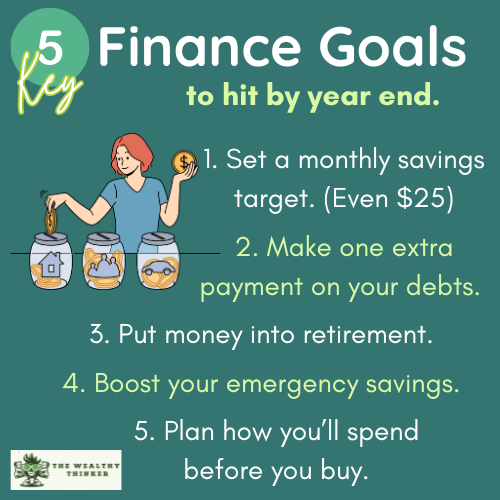
9 Personal Finance Goals to Finish 2024 on a High Note
1. Have a monthly savings target.
The first step to achieving financial freedom is through savings.
The importance of savings has been emphasized by the rising cost of living and layoffs. Still, millions of people struggle to save. According to Forbes, 28% of Americans have less than $1,000 saved.
Having a monthly savings target is a good way to sidestep the effects of the financial ups and downs – or at least soften its blows.
Starting is simple – make a monthly savings target. If this feels overwhelming for you, break it down to weekly or daily goals – it can be as simple as saving $5 a week.
The personal finance key is to be consistent in setting aside money that you’ll appreciate in the future. Plus, you’re building confidence and a fabulous habit every time you hit your goal!
2. Make one extra payment on your debts.
Some of the most expensive months and events of the year are approaching:
- Back to school
- Thanksgiving
- Christmas
- Travel
And with these, often come larger debt burdens. As such, you need to make sure you’re taking your debt payments seriously. Over the course of the rest of the year, make one extra payment on your debt (credit card, mortgage, auto loan, etc.).
Personal finance tip: Every time you make an extra payment on your debt, you are accelerating the time it will take to pay it off.
One extra monthly payment per year on your mortgage shortens the length of your loan by 4-5 years. Think of what 4-5 years of savings in mortgage payments would do for your financial situation!
3. Put money into retirement.
Inflation and recession have put many retirement plans in jeopardy.
But leaving the labor market is an inevitable fact we all will face. As we approach the end of 2024, the blatant reality is that your year of retirement is now that much closer.
Starting to save is the only way to alter it, even if it’s only a tiny bit.
Find out how to create an account, deposit some money, and start allocating a portion of your monthly income to it this year if you haven’t saved anything before.
4. Boost emergency savings.
Having quick access to money is also essential for covering unforeseen costs.
However, according to a 2022 poll by Betterment at Work, just 59% of workers have an emergency fund, down 7% from the previous year, leaving 41% without any form of safety net.
Finding temporary employment might be quite beneficial in light of the changing economy. You might be able to save more money if you work a part-time job in retail, a restaurant, or holiday decorating for hire.
Another idea is to check out high-yield savings accounts. Numerous financial institutions are offering rates much, much higher than the national average of 0.6% APY (Annual Percentage Yield).
Some accounts are paying as much as 5.15% interest with no minimum balance.
Say you open a high yield savings account with $250. If you put away $200 a month at 5.15% interest over the next 3 years, you will find yourself with $8,045.04 in your account (Providing you keep adding to it, of course.). You will have earned nearly $600 just in interest.
Either way, the current economic uncertainty demands that you should take saving for an emergency seriously.
5. Plan how you’ll spend before you buy.
Simply watch your spending if you’re unable to save additional money at the moment.
Before making a Christmas purchase, decide how you want to pay for it. You can stick to your spending plan and avoid debt by paying with cash instead of credit.
Some businesses may give you a discount if you pay with cash to avoid credit card transaction costs.
In some circumstances, purchasing in cash may result in you paying 3% less than the purchase price. Like cash payments, digital payment programs like ApplePay, Venmo, and CashApp can also be used.
You have greater consumer protections when using a credit card than a debit card, and you could also earn benefits like cash back or airline or hotel miles.
Choose a card with a low-interest rate or one with a 0% introductory APR offer, especially if you believe you won’t be able to or won’t pay off your whole debt after the monthly cycle.
6. Start a No-buy challenge.
Start a No-buy challenge for a certain amount of time (1 month, 3 months, 1 year). Choose the dates, note them on your calendar right away, and resolve to refrain from making any purchases during that period other than food and necessities.
The bonus: this personal finance option has nothing but benefits; there are no drawbacks. Along the road, you’ll discover more about yourself, reconsider your purchasing patterns, and make some savings.
7. Boost your credit score.
You can view your FICO score for free through many credit cards.
The trouble with credit scores is that while it’s crucial to have a solid one on hand whenever you need it, we can’t always predict when that will be.
Find a means to verify yours today, and then resolve to make improvements towards boosting your credit score by the end of 2024.
8. Combine resources with your partner.
If your household has two earners, try to put away one partner’s whole paycheck.
If you and your partner both have jobs, decide to live on just one income and invest the whole amount of the other person’s income.
If this sounds like something you want to try, work toward this resolution up to the end of 2024, as it will require conversation and planning!
9. Make a budget.
Since you were in high school, people have emphasized the personal finance mantra of creating a budget for yourself (or maybe even younger).
If not, get started right now. No more postponing it. The time has come!
If you’ve discovered that typical budgeting methods don’t work for you, try something alternative, like a spending plan.
You could also start small by looking ahead to the holidays. Work on a Christmas budget, taking into account how much you want to spend and on who, any food or decorating you may want to take on, etc.
Personal Finance Tips to End the Year on a High Note
The end of the year is an important time for making personal finance decisions that can have an impact in the year ahead — and for years to come. The problem is most people don’t follow through on their resolutions.
People wait for the New Year to start implementing them. But you don’t need to wait until December 31 to start a series of actions that may change the course of your life!
If you’re convinced of the benefits an action would have on your life, you will start implementing immediately because you’ll want to see the results earlier.
Editor’s note: This article was originally published Dec 26, 2022 and has been updated to improve reader experience.