


Planning a vacation is exciting – booking flights, finding the perfect place to stay, and imagining all the fun you’ll have.
But while you’re focused on relaxation, scammers are focused on taking advantage of distracted travelers.
Whether it’s fake tour tickets, sketchy Wi-Fi, or too-good-to-be-true giveaways, travel scams are more common than you might think – and they can turn your dream trip into a nightmare.
That’s why being prepared and informed is just as important as packing your suitcase.
In this article, we’re breaking down thirteen of the most common vacation scams you should be aware of – plus how to spot them before they ruin your trip.
From fake police officers to overcharging street vendors, these vacation scams can happen anywhere, whether you’re exploring a new city or lounging at a beach resort. The good news? A little awareness goes a long way.
Let’s dive in and make sure your next adventure is safe, stress-free, and scam-proof.
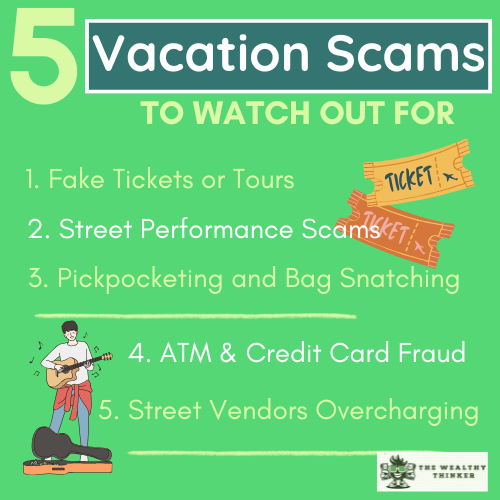
13 Most Common Vacation Scams You Need to Avoid
These are some of the most common scams to keep on your radar and avoid.
#1. Fake Tickets or Tours
When making online reservations for tickets or tours, use caution.
Use only trustworthy websites, and make sure to check the seller’s legitimacy. As a general rule, don’t click on something from an ad, rather, type in the company’s name to your search and go from there.
Don’t purchase tickets from strangers or unreliable sources, like random ads on Kijiji.
There are scams around with people selling counterfeit tickets with fake barcodes and selling duplicate tickets to multiple people.
It’s not to say there aren’t legitimate sellers out there, but don’t be sending money without checking what you’re getting.
#2. Street Performance Scam
It can be a scam if someone is playing a game or doing a magic show for you on the street!
To make the performance seem more genuine, the performer will have a bunch of accomplices who are dressed as tourists.
Their associates will pickpocket you as you attend the play. Keep a tight rein on your belongings. Keep your stuff near you and observe any performances on the street from a safe distance.
#3. Pickpocketing and Bag Snatching
Another one of the very common vacation scams is to pay extra attention to your valuables in public. In busy places, at tourist destinations, and on public transportation, keep a watch on your things and proceed with caution.
Carry your valuables in a safe bag or various money belts under your clothes and avoid keeping all of your cash and identification in one location.
#4. ATM and Credit Card Fraud
Use ATMs that are placed in well-lit, secure settings, especially inside banks or other trustworthy businesses.
Scammers can watch you enter your PIN from further away, then later pickpocket your wallet and go back to the ATM. The same goes for your credit card, cover your transactions so no one can read your PIN.
Be careful of any suspicious equipment attached to the ATM, and be wary when entering your PIN. Keep an eye out for any unauthorized charges on your credit card statements.
#5. Taxi Scams
Use trusted, licensed taxis.
Before beginning the ride, make sure the meter is running or come to a fixed fare. Be wary of drivers that demand outrageous fares or take needlessly long routes.
Even if you don’t know the area, you can always use your phone’s Maps app ahead of time, or even in the cab to make sure they aren’t taking an unnecessarily long route.
Simply go to your phone’s Maps app and type in your destination. It will provide you with a map, directions and the estimated time and distance to make your trip.
#6. Fake Police or Authorities
Watch out for those demanding to see your identity or alleging that you have committed a crime.
They could be impersonating police officers or other law officials. When in doubt, seek help from your embassy or consulate, go to the local police station, or ask for proper identification from the person.
#7. Street Vendors and Overcharging
From fake brand name purses and wallets, to ‘valuable jewelry’, this is one of the most common vacation scams.
When dealing with street vendors, be vigilant, as they may be trying to overcharge or give you fake money as change.
Find out what the going rate for a product is, then bargain if required. When buying expensive products like jewelry or gadgets, use caution and only shop from reputed retailers.
#8. Fake or Unsafe Wi-Fi Networks
When connecting to public Wi-Fi networks, particularly those without passwords, exercise caution.
False networks can be created by scammers to steal personal data. For further security, use a virtual private network (VPN) or rely on reliable mobile data networks.
It may not be possible everywhere, but using your hotel’s Wi-Fi (Which is usually private to that building.) is safer than letting your device connect to any open network.
#9. Unsolicited Offers or Distractions
People who volunteer to carry your baggage or give you instructions without asking are to be avoided.
Some may be targeting you, trying to pickpocket you, or cause a distraction while an accomplice steals your possessions.
#10. Accommodation Scams
Use dependable travel agencies or websites to make your hotel reservations.
The old way to do this was to look for the padlock in the top left corner of your screen. This means the website is SSL certified, and there are steps to ensure your data is secure.
If you’re on Google Chrome however, they changed this method, so now your best bet is to look for websites that start with https:// or you can view site information in the top left of your screen, right in front of the name of the website you’re on.

If the connection is not secure, don’t use it. Offers that look too good to be true should be avoided, as should requests for payment in advance without adequate justification.
#11. Empty Wallet Scam
Avoid falling victim to the Empty Wallet Scam.
The scam works by:
- The scammer places a wallet on the strategically on ground
- Instinctively, you check your wallet as you pass it out of the blue to make sure it’s secure
- Unbeknownst to you, the scammer will notice where you looked for your wallet
- They will be able to pickpocket you later because they will know exactly where you placed it
When ever you see a wallet on the ground, especially if it is placement is obvious, continue walking, or at least resist the urge to check your wallet.
#12. Charity Scams
When approached by somebody claiming to speak for humanitarian organizations, use caution.
To make sure your donation reaches individuals in need, do your research on the organization and donate directly to them, via their website, or an obvious location, like a central office.
While many charities rely on volunteers raising money or awareness in public places, scammers can just be too good at pretending they are legitimate.
A good practice is to talk to the people if you are interested in supporting the cause, but ask for additional information, so you can decide if you want to donate later.
Even taking your wallet out in the middle of the street can make you a target. Anyone can see how much money you are carrying and where it is.
#13. Giveaways
Look out for fake giveaways like a cost-free trip or a cheap travel deal, particularly if you have to pay a fee to get your prize.
It’s crucial to read the terms and conditions and fine print of any sweepstakes. Keep in mind that if something seems too good to be true, it generally is.
Be very cautious about giving out your personal information, and ask what they intend to use it for.
Buying or Selling Online? 4 Ways to Protect Yourself From Scams
Vacation Scams: Be Wary & Vigilant!
Remember to trust your instincts, stay alert, and be cautious when traveling.
It’s always a good idea to research your destination and be aware of the common scams that occur in that area. Stay informed, practice common sense, and prioritize your safety and security while enjoying your travels.
Editor’s note: This article was originally published Jul 5, 2023 and has been updated to improve reader experience.