



Listen, people are touchy about money.
We don’t like to talk about it and especially not when we’re worried we don’t have enough or will be in trouble down the road if we do it wrong.
The fact is, if you want to maximize your money, you need to think about it differently. Little things add up. This is why Dave Ramsey called his book ‘Baby Steps‘ (But that’s a different article.).
Managing your finances should be a consistently progressing project. You have to make choices that will affect your money every single day. Everything you decide to buy makes an impact. So having a few extra tips in your arsenal will add up over time.
Appropriately, we’ve collected 15 insanely simple tips to help you maximize your money and think more frugally. You can thank us when you hit your financial goals sooner than expected!
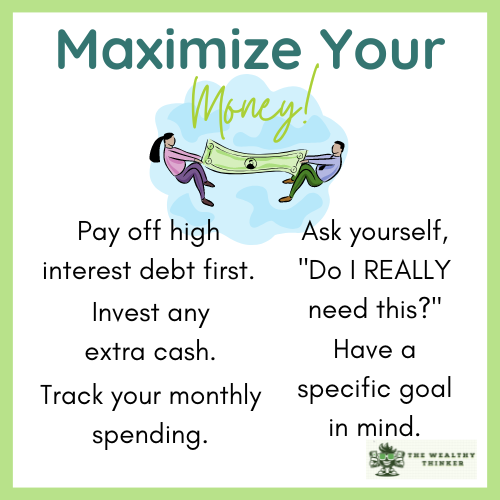
15 Ways to Maximize Your Money with a More Frugal Mindset
1. Keep a record of your monthly spending.
“Make a budget – ya, ya, ya.” But listen. There’s a reason every financial advisor, blog and book will tell you to start here.
How do you know what your money is doing if you’re not tracking it?
Many of us really resent being reminded of where our funds go every month. But keeping track of them can uncover money-saving methods you can use for a more worthwhile cause. (Goals anyone?)
Keep records of your expenditures for a couple of months to start with. It will help you find and trim the fat in your monthly budget.
Side Challenge: If you don’t think you need a budget, make a bet with yourself for how much you think you’re spending (Not on bills) in a two week period. Then, for the next two weeks, go about your business normally. After the two weeks, go back and look at what you spent. How close or far off were you?
I did this once years ago, when I was saving money for a new couch. I ate out for lunch every day and my husband and I ordered out 3-4 times a week. I would have said I spent a few hundred dollars a month on take out food. Picture my face when I did the math and realized I was spending $500 a month on food. Not including groceries. Just lunches, take out dinner and snacks.
2. Don’t be afraid to buy used.
Look for second hand or thrift stores in your neighborhood; check Facebook Marketplace, go to garage sales.
You should be able to find less expensive things there, especially things like tools, gardening stuff, furniture, office equipment, pet supplies.
Take the time to research how much things cost new and you’ll be prepared for knowing what a real deal looks like. Getting into this habit can really add up in the long run.
3. Put extra cash into an investment.
Windfall? Bonus? Unexpected money from selling something, or a birthday?
We know. You want to go out and treat yourself. Or you’re suddenly a little more enticed than usual when you see something in a shop. And that’s okay! Once in awhile.
It’s probably not as fun as blowing it all on new clothes, a gadget, or another knickknack for your home, but next time this happens, throw half of the total into an investment.
Put the money into an investment or savings account, or an emergency fund as soon as you have the opportunity – before spending. This is an excellent habit to get into!
4. Avoid using your credit card and make as many purchases in cash as possible.
Another key way to maximize your money is to stick to cash or debit! Then it’s fully paid off already.
Get into the habit of only using your credit card in an emergency or for large purchases that you can’t make with cash.
If you have to use credit for bigger purchases, whether it’s a vehicle, a house, or an appliance, keep in mind what your monthly payments will be in the future. (And the loan interest rates!)
Being realistic about how long it will take to pay something off, plus planning up front for things like interest, will help you avoid nasty financial surprises down the road.
This habit will also make you think twice before you throw your card down.
5. Ask yourself, “Do I REALLY need this?”
We’ve gotten used to having a lot of things that aren’t needed. Some of us just get into the habit of buying stuff without really thinking about why.
If you’re trying to get ahead, ask yourself – what are the things you need to cut back on first? Most of the things people covet are not absolutely essential to their existence.
To maximize your money, reduce your expenditures and instead, appreciate the rewards of saving.
6. Multiple bank accounts are a good idea.
You’ll need money for a variety of purposes, including:
- day-to-day needs
- long-term or short-term investments
- long-haul reserve funds
For each reason, you ought to have an alternate ledger. This brings structure to your money and makes it easy to see how it’s doing in general.
7. If you require dental services, go to a dental school.
These facilities provide high-quality, supervised dental care for a negligible portion of the expense of visiting a customary dental specialist’s office.
Check out the location of the nearest dental school in your area with a quick Google search for ‘dental schools near me.’
8. Find smart options to save money on your phone package.
You must purchase your phone upfront with a contract-free plan, and you will save money on monthly fees.
If you want to get a good deal on a phone, you’ll probably have to commit to a two-year contract. If you wish to add extra individuals to a family plan, a contract option may make more sense.
9. Make sure you have decent medical insurance.
Having appropriate medical insurance is one of the things you can do to keep your financial situation in excellent shape.
Medical expenditures linked with becoming sick, unwell, or wounded have the potential to bankrupt you financially. It’s critical to prepare for these scenarios.
10. Never invest more money than you can bear to lose in a deal.
This implies that if you lose any cash it ought not to bankrupt you monetarily.
You must ensure that any equity you may have is safeguarded.
Investing is always going to involve some level of risk, but you can mitigate it by diversifying your choices – meaning you should never put all your eggs in one basket.
11. Bring your lunch to work!
An oldie, but a goodie – because it’s an easy-to-control way to maximize your money immediately. The fact is, when you go out for lunch every day, not only are you spending more time, but you’re almost certainly spending more money.
Depending on where you work and what’s available to you, you could easily spend $15-20 a day on your afternoon meal.
On average, you can make a decent and nutritious lunch for $5, especially if you’re eating leftovers from the night before. But go out for even a fast food lunch and you’re dropping at least twice that, more if you’re trying to eat healthy with a decent wrap or fancy salad.
Assume you save even $5 every time you bring your lunch. At even 3 days a week, you’re saving $60 a month – and that’s not counting any fancy lattes, pastries or extras you pick up on your trek to find food.
Not sure where to get started? Check out our excellent series on budget lunch ideas!
12. Pay off your high interest debt first.
Another super smart way to maximize your money. Do you want to spend more money paying something off than its actually worth? Of course not.
But this is what happens when you let your highest interest loans hang around, because you know compound interest is just going to keep adding to your overall total.
Prioritize paying off the debts that carry the higher interest prior to zeroing in on the lower or no interest obligation.
Paying only the minimums on a high-interest credit card might end up costing you hundreds of dollars more than necessary.
Start by listing all of your credit cards’ interest rates and pay off the ones with the highest rates first.
Snowball, Fireball & Avalanche: 3 Powerful Debt Payoff Methods to Help With Yours
13. If you own a house, research any deductions or tax breaks.
At the point when you put resources into a house, there are a few new things that you need to know in regards to your charges.
You will find that you are presently qualified for certain deductions or tax breaks that you were never qualified for before.
For example, you may be able to deduct the mortgage interest on your home loan and your local charges.
14. Have a specific goal in mind if you want to change your habits.
Rather than simply deciding you should set aside more cash, nail down something specific you need to save for. Your new mentality will quickly lead to new habits.
For example – the next time you’re tempted by a sale or a shiny new thing, it will be a LOT easier to turn it down if you have a goal for something more important to you.
If your financial goal is broad, like “I want to save $5,000 in the next 5 years,” that’s still a great goal! But that’s a long way off. It’s easy to just think, “I have lots of time to save that amount…I want that shirt/hat/wallet/game now.”
But imagine instead that your goal is, “I’m saving up for a trip to New York next April and I know I need $4,000 in the bank to pay for everything I want to do.”
You now have a clearer, time sensitive and specific goal in mind – and are much more likely to make more thoughtful decisions to maximize your money.
A Financial Vision Board is a Powerful Catalyst to Help You Reach Your Goals
15. Your finances should be managed consistently…
…with the goal for them to remain on the track that you set for them.
Setting goals and budgets is a fantastic way to get started when you want to maximize your money!
But if you don’t adapt, track, check in and learn as you go and grow, it won’t matter what you had planned.
Being an active participant in managing your money is the very best way to find success.
You Can Maximize Your Money With a Little More Attention to Details!
This article has given a couple of important pointers that should help you in navigating and perfecting your financial security.
Even if you only adopt a few strategies suggested in this article, you will be much farther ahead when it comes to being able to maximize your money.
Editor’s note: This article was originally published Sep 7, 2021 and has been updated for improved readability.