



When you grind for so long to save up money, finally getting to take the vacation you deserve feels like a million bucks.
But even though you may feel the need to indulge and give yourself a treat, there are smarter ways for you to unwind during vacation without putting all the chips on the table.
You don’t want to come back broke after your vacation only to start the hustle all over again.
With this in mind, it only makes sense to adopt some savvy strategies to save money on vacation by cutting your budget if you don’t want to burn a hole in your pocket.
Follow as many of these tips as you can to help you have a memorable vacation without breaking the bank. (And you can go on your next vacation faster when they work!)
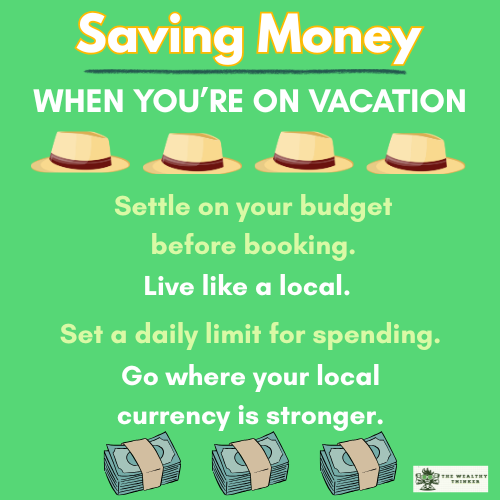
8 Simple Ways to Save Money on Vacation
1. Find the best deals.
The most obvious way to cut costs is by finding the best deals.
However, this takes planning and patience, because you have to be ready to pounce when the opportunity presents itself. Businesses in the travel and leisure industry normally give promos or discounts to tourists as an incentive for their patronage.
It’s not uncommon to find airlines giving discounts to certain destinations, or hotels offering discounts to visitors.
But here’s the trick: these opportunities are not always publicized. You have to be checking on their sites and social media constantly.
This can be draining and energy-sapping for something that’s supposed to give you relief from the stress of work and everyday living.
A very good alternative is browsing travel blogs for any information. While some blogs do not hoard information and bare it all for readers, others only send alerts to subscribers through newsletters.
Information could include:
- low-cost airlines
- promos and discounts
- the best way to get guides
- booking a taxi at your destination
- the affordable spots to stay in your preferred vacation spot
2. Budget before booking.
Set a vacation budget before booking your trip.
It’s a smart idea to have a fixed amount you want to spend, but when planning, try to settle your budget around a lower figure. For example, if you’ve saved up $5,000 for your vacation, when planning, set your budget around $4,000 or $3,500.
The extra cash allows you to take care of any emergencies or unbudgeted expenses that may crop up during your vacation. If you don’t get to spend the cash, you can invest it, plus having a lower amount to work with means you’ll be more cautious with your spending.
Flights and accommodations will probably be the biggest expenses, so pay attention to the details and find how to cut costs in those areas. Find as much as possible about your vacation spot and juggle between alternatives before making a final choice.
Looking at price comparison sites such as kayak.com or Travelocity can also help you make sure you’re getting the best deal.
3. Go where your local currency is stronger.
The best way to get value for your money is by traveling to destinations where the dollar is stronger than the local currency.
Luckily, there are many places where your money is worth a fortune rather than a pittance. Countries in Eastern Europe or the Balkans are good vacation spots.
Instead of going to Japan, you can go to other south-east Asian countries such as Malaysia or Vietnam. Economies where the dollar (or your local currency) is stronger gives you an extra treat for your spending.
You afford luxuries that may cost a fortune in other countries, plus you feel more relaxed and can be more carefree with your spending.
4. Carry a debit card.
Carrying a credit card comes with the danger of overspending.
To curtail this, it is best you travel with a debit or prepaid card. A debit card puts a cap on your spending. You know that once the funds on the card are exhausted, you are out of cash and can’t borrow.
This way, you’ll be much more conscious of how you spend money. Depending on the country or location, you may also get some discounts paying in cash instead of paying with a credit card.
- do your research ahead of time to make sure your local debit card can be used in different countries, or if you should bring cash. Bring your credit card for emergencies, but don’t plan on using it.
5. Set a daily limit for spending.
This is your overall budget broken down to daily spending limits.
This is an effective way of keeping your spending in check during a vacation. This can be done by simply dividing your total amount (minus traveling and accommodation costs) by the number of vacation days.
So if you decide on having $2,000 for a week long vacation’s worth of food, activities, shopping, etc. you’ll need to stay at or under $286 a day.
If you prefer holding cash, get an envelope for each day of the vacation. Use just the cash or gift cards in the envelope for that day, and if there is any leftover, put it in the envelope for the next day.
6. Travel mid-week.
Rather than traveling during the weekend when traffic is heavier for travelers, why not travel mid-week?
Apart from fewer commuters to deal with, you could also save some money on travel costs. Booking travel mid-week can yield savings of over 35% on airfare and hotels. Hotels tend to have lower rates on weekdays than on weekends.
Traveling mid-week also means that you have more days to spend on your vacation.
7. Cook some of your meals.
Of course, you want to enjoy the local food when you’re on vacation, but eating out a lot can add up quickly and take away from other experiences during your trip.
Rent accommodations that have a kitchenette if you plan to stay beyond a week, so that you can cook some quick meals in your room.
An easy way to do this is to pick one meal a day you’ll make in house. Maybe you decide to have croissants, yogurt and fruit from the local vendors for breakfast every day instead of going to a restaurant.
Check to see whether the hotel you’re staying at has free breakfast, or carry leftovers from a restaurant back to your room to eat the next day. If you go somewhere with huge portions, consider splitting entrees with your travel partner, or ordering appetizers instead.
8. Live like a local.
One of the best ways to save money on a vacation is to live like a local.
Let’s face it, tourism is big business. Behind the smiling and welcoming faces are business people who want to make money by providing services to tourists. This is why tourists pay more for items than locals.
As such, to save money you have to live like a local. Rather than eating out at the fancy hotel restaurants, what don’t you inquire about local eateries, restaurants, or cafes? Instead of staying in a hotel, you can rent a house and live within the local community.
Instead of visiting the top designer brands, you can shop at the local grocery stores and supermarkets. This would enable you to get a feel of what the country is truly like, plus you get to save costs because you would be buying things like a local, rather than a tourist.
Editor’s note: This article was originally published Dec 13, 2021 and has been updated to improve reader experience.
Photo by Upgraded Points on Unsplash