



Having a car is so ingrained in our society. Our highways and road systems make it such that you may need a car to get around.
But if you live somewhere where you can walk, use public transportation, or do car sharing, you could be in a situation to become totally car free.
The financial benefits of being car free go well beyond a car payment. AAA has evaluated that the cost of owning a car for one year is about $10,000. This doesn’t include car payments but accounts for the following:
- gas
- wear and tear
- general maintenance
Are you curious about going without a vehicle? Keep reading to discover all the financial benefits of being car free.
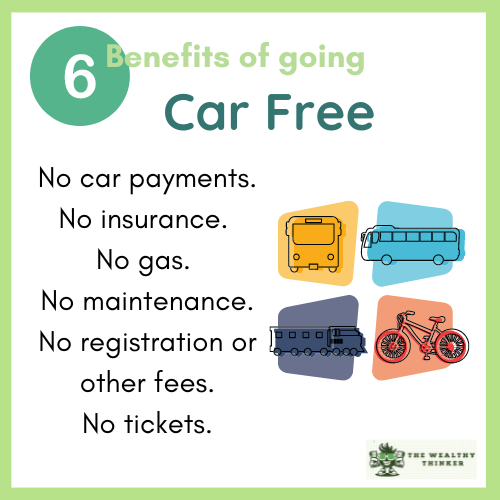
6 Financial Benefits of Going Car Free
No car payments.
Most individuals need to finance a car, which means they will have a car payment.
Typically you will have to put a percentage of the car down when you purchase, and the rest will be paid monthly through car payments.
The average car payment for a new car is about $700. The average car payment for a used car is about $500.
Not having a car means that you won’t have any monthly car payments. Over a year, this cost can range from $6,000 to $8,400 a year. This money you will be saving can be used to help cover your public transportation costs or other modes of transportation since you still need to get around.
No gas.
If you don’t have an electric car, you will have to buy gas for your vehicle.
Not only does this take time every week, but there is a cost to this. Gas prices fluctuate, but the average monthly cost of gas is around $150 – $200.
Over a year, this is $1,800 to $2,400. This is just the average and can be even higher when gas prices are at a peak.
If you look at the cost of a car payment and gas at the high end, you are already looking at $10,800 a year for a car, and these are only two costs of owning.
Without a car, you won’t have gas costs to worry about. This money can be used towards other monthly expenses you have or even towards your savings.
No insurance.
If you own a car, you legally have to have car insurance to cover any damages.
Insurance costs vary greatly depending on your credit score and driving history. The average monthly payment for full coverage car insurance is $143 or $1,718 a year. (This depends on your state, driving record, car make and model, etc.)
Now, we are looking at $12,518 a year for a car with three expenses. Car insurance can be as expensive as $4,000 a year if you’ve had a DUI.
Not only will you have no car insurance for being car free, but you won’t have to worry about getting into an accident and paying the deductible before the insurance covers the rest.
Not only is this a financial benefit, but it’s also a general benefit of not having the stress of owning a car.
No maintenance.
A car is a machine in need of regular maintenance and tune-ups to keep it in the best condition. Having regular car maintenance will have your car last longer. Depending on how many miles you’ve racked up, you will have to:
- change your oil
- rotate your tires
- get new tires
- replace a battery
- replace brake pads
- And more!
Each of these services can range from $50 – 1,000. This also can vary with the type of car. More premium car brands will range on the higher end. The frequency of when you need to have your car maintained also varies on how much you drive it.
For the first 30,000 miles driven on a car, the estimated maintenance cost is around $658 – $871. So now, owning a car is around $13,389.
Not owning a car means you won’t have to pay any maintenance fees, but you also save time because you won’t have to schedule these appointments.
Registration and other fees.
When you own a car, the state you live in treats a car like property, so you will owe taxes and possibly other fees for your car. Each state varies and has different ways to price what you owe in registration. As of 2018, vehicle registration prices range from $8 to 225.
Not owning a car means you won’t have to go through the process of registering your car or paying that fee.
No tickets.
When you drive a car, you must ensure you follow driving laws. If you don’t, you can get tickets for:
- speeding
- not having your lights on
- following too closely
- parking violations
- and so much more
All of these tickets can have associated costs and may even impact your insurance cost.
Not owning a car means you won’t have to worry about getting a ticket for driving.
Final Thoughts on Being Car Free
A car can provide someone with so much freedom and help them get to their jobs, but for others, it’s a cost that can be crippling. $10,000 a year for a car seems like a high cost, but millions of Americans pay this fee for just one car.
If a family owns more than one vehicle, they’re looking at $20,000 or more for ownership. Going car free (Or even going down to one car) can allow you to use that money on other bills like your rent or to your emergency fund, investments, etc.
Utilizing resources like public transportation and car sharing allows you to still get around while also saving money.
Editor’s note: This article was originally published Feb 18, 2023 and has been updated to improve reader experience.
Photo by noelle-design on Canva