



Recognizing that you’re living beyond your means can be tricky, but certain signs can serve as financial red flags.
In this article, we’ll delve into the seven most telling signs that indicate you’re living a lifestyle you can’t truly afford. Recognizing these signs early can make a significant difference in turning your financial life around!
The objective here isn’t just to alarm you but to offer actionable advice and strategies to get back on track.
The importance of these signs cannot be overstated, as failing to take action can increase your financial woes. So whether you’re deeply entangled in a web of financial commitments or simply looking for ways to be more fiscally responsible, read on.
Each section offers both a diagnosis and a treatment plan, so to speak, for these common financial ailments.
Table of Contents:
3: Frequent Use of Loans and Borrowing
4: Struggling to Pay Bills on Time
5: Neglecting Retirement Savings
6: Living Paycheck to Paycheck
7: Maintaining an Unmanageable Lifestyle
How do you know if you’re living beyond your means?
One of the most straightforward, yet elusive concepts in personal finance is the idea of “living beyond your means.”
Simply put, this term refers to the act of consistently spending more money than you earn.
While the repercussions may not be immediately apparent, living beyond your means can have far-reaching consequences. Over time, this financial misstep can accumulate overwhelming debts, stress, and a negative credit history.
The long-term implications can be severe, often affecting your current lifestyle and future financial security.
The importance of financial awareness.
In a world that often encourages consumerism, financial awareness is not just a luxury but a necessity.
Good financial health is linked to reduced stress and improved mental well-being. On the other hand, poor financial literacy can lead to a series of poor decisions, like taking on excessive debt, which can trap you in a never-ending cycle of financial instability.
No one is immune to making money mistakes; hence, financial awareness is a skill that everyone—irrespective of their income level—needs to cultivate.
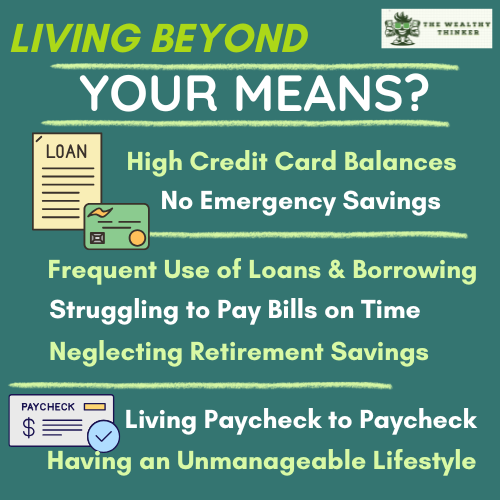
The 7 Signs You are Living Beyond Your Means
Sign 1: High Credit Card Balances
Explanation of Credit Card Debt as a Red Flag
Consider it a big red flag if your credit card balances are sky-high and you find yourself just paying the minimum due every month:
- Carrying high balances on your credit cards can significantly and adversely affect your credit score. The higher the balance, the lower the score, as it signals to creditors that you’re possibly overextended and less likely to pay back borrowed money.
- A higher balance naturally leads to more interest payments. Over time, these can compound into a mountain of debt that becomes increasingly difficult to overcome.
- The emotional toll of rising credit card debt should not be underestimated.
The looming cloud of financial stress can lead to anxiety, sleepless nights, and strained relationships.
How to Calculate Your Credit Card Utilization Rate
A vital but often overlooked metric is your credit card utilization rate.
This rate represents the ratio of your current credit card balances to your credit limits. A high utilization rate could seriously harm your credit score, as it indicates potential financial instability.
To calculate it, divide the total balance by the total credit limit, then multiply by 100 to get a percentage.
For instance, if you have a $2,000 balance on a card with a $10,000 limit, your utilization rate would be 20%. A lower rate is always better; experts often recommend keeping it under 30% to maintain or improve your credit score.
4 Strategies to Reduce Credit Card Debt
If you are burdened by credit card debt, several strategies exist to reduce it effectively.
- Debt Snowball Method: This involves making minimum payments on all debt accounts, but focusing any extra money on the smallest debt. The idea is to gain momentum as you pay off smaller debts, which encourages you to tackle larger debts.
- Debt Avalanche Method: This approach focuses on first paying down the debt with the highest interest rate. It may save you more in interest payments over time, but can be more challenging emotionally if the highest-interest debt is also one of the largest balances.
- Balance Transfers: Transferring your credit card balance to a card with a lower interest rate can give you a temporary reprieve from high interest rates, allowing you to pay down the principal more quickly. However, be aware of transfer fees and the expiration of the low introductory rate.
- Automated Payments: Setting up automated payments can help you always meet a payment deadline, lowering the risk of late fees and potential hits to your credit score.
Armed with these strategies, the uphill battle against high credit card balances can become more manageable. The key lies in both recognizing the red flags and taking timely, decisive actions to limit the damage.
Sign 2: No Emergency Savings
The Significance of Emergency Funds
The absence of an emergency savings fund indicates that you may be living beyond your means.
Financial experts, from Dave Ramsey to Suze Orman, all concur on the importance of a financial safety net. An emergency fund serves as your fiscal lifeboat when unexpected expenses arise, such as sudden medical emergencies, car repairs, or job loss.
An emergency fund gives you the peace of mind and financial stability to tackle these unplanned situations head-on without resorting to high-interest credit cards or loans.
Tips on Building an Emergency Fund
Creating an emergency fund can feel daunting, but with a disciplined approach, it’s entirely achievable.
Consider saving at least 20% of each paycheck specifically for this purpose. It’s also good to separate your emergency savings from your daily expenses by keeping them in different accounts. This makes it less tempting to dip into your savings for non-emergencies.
Taking advantage of automatic transfers can simplify the process, directing a portion of your income straight into your savings account without you having to think about it. Over time, this “set it and forget it” approach can amass a sizeable safety net.
How to Determine an Appropriate Emergency Fund Size
The question then becomes, how much should you save?
A common guideline suggests keeping an emergency fund that can cover at least three to six months of living expenses. However, your individual circumstances may require a different amount.
For instance, you might need a more substantial cushion if you have:
- dependents
- substantial debt
- or irregular income
Make it a practice to revisit and reassess the size of your emergency fund annually or after significant life events like marriage, having a child, or buying a house. Changes in your situation might necessitate a change in your savings strategy.
The lack of an emergency savings fund puts you at considerable financial risk and is a sign that you might be living beyond your means.
Not only does it leave you vulnerable to unexpected financial shocks, but it also can lead you further down the path of debt and financial insecurity. Taking active steps to build and maintain this fund is a cornerstone of sound financial planning.
Sign 3: Frequent Use of Loans and Borrowing
Different Types of Loans and Borrowing
If you routinely take out loans or borrow money, this could be another sign that you’re living beyond your means.
People commonly rely on several types of loans, including:
- personal
- payday
- and auto loans
While some loans might be necessary for significant life events or purchases, others, like payday loans, are notorious for their high interest rates and can quickly trap you in a cycle of debt.
Borrowing from friends and family, while it can seem more benign, can also signal financial distress and may damage important relationships.
When is Borrowing Acceptable?
Not all borrowing is detrimental.
Some loans are useful and can be seen as an investment in your future.
- Mortgages enable you to own a home
- Student loans can finance a potentially lucrative education
These can be considered ‘good debt’ because they are likely to increase your net worth or produce value over time.
However, the red flag is raised when loans are taken out for daily expenses or to service other debts. Borrowing under these conditions usually indicates that you need to live within your means.
Signs That You are Over-relying on Loans
If you frequently take out new loans to pay off old ones, that’s a definite sign you are over-relying on borrowed money.
This cycle can be disastrous, leading to a seemingly unending loop of debt that becomes increasingly hard to escape. To quantify your reliance on loans, consider calculating your Debt-to-Income (DTI) ratio.
This measure divides your total monthly debt payments by your gross monthly income, giving you a percentage that can be valuable in assessing your financial health.
A high DTI ratio may indicate that you need to focus on reducing your debt load as soon as possible.
The frequent use of loans and borrowing to sustain your lifestyle is a precarious financial strategy that can lead to an intractable cycle of debt.
While some borrowing can be justifiable and beneficial under the right circumstances, it becomes an issue when it contributes to an unmanageable lifestyle. Assessing your habits around borrowing can provide invaluable insights into whether you are living within or beyond your means.
Sign 4: Struggling to Pay Bills on Time
Importance of Bill Payment Punctuality
Struggling to pay your bills on time indicates that you may be living beyond your means.
Late payments can have multiple repercussions that compound over time:
- They often lead to additional fees, increasing your overall debt burden.
- A history of late payments can severely damage your credit score. This makes it more difficult to secure future loans, mortgages, or even housing rentals.
- The psychological stress associated with constantly juggling bills and living on the edge of financial ruin can be immense and harmful to your overall well-being.
Creating a Budget and Financial Calendar
If you struggle with punctual bill payments, it’s time to create a budget and a financial calendar.
Several budgeting approaches exist, from specialized apps to old-school methods like spreadsheets. The key is to find a method that you will stick to. A financial calendar can supplement your budget by visualizing upcoming bills, helping you plan accordingly.
Automating your bills can also be a great way to reduce the chances of missing a payment. Just make sure you have sufficient funds in your account to cover the automated expenses.
Strategies to Avoid Late Payments
If you know that a bill will be late, proactive negotiation with creditors can sometimes result in waived or reduced late fees, so don’t be afraid to pick up the phone before the due date.
Another strategy is to rearrange your bill due dates to align with your payday, making it easier to pay them on time. Many companies are flexible about this. Additionally, keeping a small “buffer” in your checking account can save you from unexpected expenses that might otherwise cause you to miss a bill payment.
Falling behind on bill payments can cascade into a series of financial hardships, affecting everything from your credit score to your emotional well-being.
Implementing budgeting strategies and utilizing a financial calendar are proactive steps toward financial stability. If you find yourself unable to meet bill payments consistently, it’s a red flag that you need to reassess your lifestyle and make the necessary changes to live within your means.
Sign 5: Neglecting Retirement Savings
Why Retirement Savings are Crucial
Neglecting to save for retirement is a glaring sign that you might be living beyond your means.
Failing to plan for retirement can be detrimental for a multitude of reasons.
- First and foremost, the future cost of living and inflation will almost certainly be higher than it is today. This makes early planning imperative.
- Second, the power of compound interest works best when given time; the earlier you start, the more your money grows without any additional effort on your part.
- Third, while social security or a pension might seem like reliable fallbacks, these systems have their limitations and are generally not designed to cover all your expenses in retirement.
How to Calculate Retirement Savings Goals
Calculating how much you’ll need for retirement can be complex, but there are general rules of thumb and formulas to guide you.
For instance, some financial experts recommend aiming to have at least 25 times your expected annual expenses saved by the time you retire. Consulting a financial advisor is highly recommended for personalized advice tailored to your specific needs and circumstances.
Common benchmarks suggest that you should save at least 15% of your retirement income, including any employer contributions.
Strategies for Boosting Retirement Savings
When it comes to actually building your retirement savings, multiple avenues are available to you.
Employer-based retirement options like a 401(k) are usually the easiest to start with. This is especially so if your employer matches contributions up to a certain percentage. This is essentially “free money” that can dramatically speed up your savings.
Individual retirement accounts like Roth IRAs offer tax advantages that can benefit you in the long term. Periodically increasing your contributions, especially after receiving raises or bonuses, can also significantly impact your retirement fund’s growth over time.
Failure to save for retirement is a serious financial misstep you can’t ignore.
By understanding the factors that make retirement savings crucial, setting achievable savings goals, and employing strategies to meet those goals, you can help ensure that your later years are as comfortable as possible.
If retirement savings aren’t a part of your current financial picture, consider it a red flag and take the necessary steps to correct course.
Sign 6: Living Paycheck to Paycheck
Understanding the Paycheck-to-Paycheck Cycle
Living paycheck to paycheck is another surefire indicator that you’re living beyond your means.
When you find that your income barely covers your essential expenses, leaving you with next to nothing at the end of the month, you’re in a dangerous position. This kind of lifestyle leaves no room for unexpected expenses like medical emergencies or car repairs.
The emotional and financial stress of living on the edge can be overwhelming. And it contributes to a cycle that’s difficult to break. The long-term implications are even more unsettling, ranging from a lack of savings for your future to potential debt accumulation.
9 Straightforward Steps to Help You Break the Paycheck-to-Paycheck Slog
Steps to Break the Cycle
Creating a detailed budget is the first step to breaking free from the paycheck-to-paycheck cycle.
Knowing exactly where your money goes each month is key to finding areas where you can cut back. The concept of ‘wants’ vs. ‘needs’ becomes crucial here.
Examples of ‘wants’ that can be trimmed to make room for essential ‘needs’ like rent, utilities, and groceries:
- dining out often
- high-end subscriptions
- impulsive shopping
Beyond expense-cutting, consider ways to increase your income. This could be through negotiating a raise at your current job or taking on a side hustle.
Creating a Budget to Improve Cash Flow
To create an effective budget:
- Start by tracking all your income sources and expenses.
- Use budgeting apps, spreadsheets, or a simple pen and paper to understand your financial state clearly.
- Once you’ve identified where your money is going, scrutinize these areas for opportunities to cut back.
It could be that premium breakfast you buy every morning or the streaming service you hardly use. Eliminating or reducing these kinds of expenses can improve your cash flow, which is essential for achieving financial stability and freeing yourself from the paycheck-to-paycheck lifestyle.
Living paycheck to paycheck is a stressful and unsustainable way of life. By understanding the dire implications of this lifestyle, taking proactive steps to break the cycle, and maintaining a budget that ensures a positive cash flow, you can begin to live within your means.
This transition won’t happen overnight, but the long-term benefits for your financial and emotional well-being are well worth the effort.
Sign 7: Maintaining an Unmanageable Lifestyle
The Dangers of Lifestyle Inflation
Lifestyle inflation is a phenomenon that often accompanies increases in income. While upgrading your lifestyle with every pay raise or bonus may be tempting, this behavior can have detrimental financial impacts in the long run.
The more you earn, the more you may feel compelled to spend on bigger homes, luxury cars, or frequent vacations. This cycle can put you on a financial treadmill, where, despite earning more, you’re unable to get ahead financially.
Moreover, the psychological aspect of lifestyle inflation can make you feel perpetually dissatisfied. You’re always chasing the next best thing without enjoying what you already have.
Identifying Areas of Unnecessary Spending
The first step to curbing lifestyle inflation is to identify areas where you’re overspending.
Common culprits often include:
- dining out
- entertainment
- and luxury goods
To get a better view of your spending habits, consider tracking all your expenses for a month.
Categorize them into ‘needs’ and ‘wants’ and perform a cost-benefit analysis. Ask yourself, “Is this purchase improving my quality of life in a meaningful way?” If not, it’s a candidate for elimination or reduction.
Tips for Scaling Back and Living Within Your Means
Scaling back doesn’t have to mean sacrificing happiness or quality of life; it means making more conscious choices.
- Consider trying minimalism or frugality as a lifestyle choice, focusing on what adds value to your life instead of what society dictates you should have.
- Setting financial boundaries can be another effective strategy.
- Create spending limits for various categories in your budget, and stick to them.
To make a more dramatic change, consider taking on a ‘no spend month’ to reset your spending habits.
This means avoiding all non-essential purchases for a set period, helping you become more aware of your spending patterns.
Maintaining an unmanageable lifestyle is not only financially risky, but also emotionally draining.
Lifestyle inflation can easily lead you into a trap of living beyond your means. But by recognizing the dangers, identifying areas where you can cut back, and adopting a more mindful approach to spending, you can live a more satisfying life within your financial means.
Living Beyond your Means: Conclusion
Recap of the 7 Signs of Living Beyond Your Means
As we’ve explored, living beyond your means can show up in various ways.
- High credit card balances not only ruin your credit score, but also subject you to an endless cycle of interest payments.
- A lack of emergency savings leaves you vulnerable in unexpected situations, and frequent borrowing, especially for bad debts, can put you in a financial hole. Struggling to pay bills on time leads to late fees and stress, and neglecting retirement savings puts your future at risk.
- The paycheck-to-paycheck lifestyle adds financial and emotional stress. An unmanageable lifestyle inflated by unnecessary luxuries can leave you in a cycle of dissatisfaction.
Recognizing these signs early can be the first step in reclaiming your financial stability.
The Benefits of Financial Stability
Financial stability offers more than an impressive bank balance; it grants peace of mind.
It provides you with the emotional and psychological bandwidth to focus on things that truly matter in life beyond just scrambling to make ends meet.
Financially secure individuals also have more opportunities. They can take calculated risks in investments, travel, or even changing careers without worrying about immediate financial fallout. Other life goals, like homeownership, can also become more attainable.
Encouragement to Take Action and Make Positive Financial Changes
If you’ve identified with any of the signs discussed, taking action now is crucial.
Financial well-being is an ongoing journey, and there is always time to start.
Each step you take brings you closer to financial stability, whether it’s:
- consolidating your debts
- setting up an emergency fund
- or merely tracking your expenses
Bookmarking this article or even printing it out can help you revisit these guidelines and measure your progress.
In conclusion, recognizing and acting upon the signs of living beyond your means can dramatically improve your financial health. Taking calculated and conscious steps today can pave the way for a secure, prosperous tomorrow.
Editor’s note: This article was originally published Apr 20, 2024 and has been updated to improve reader experience.