


Ever heard of the “keep the change” or “round up” savings programs that banks offer?
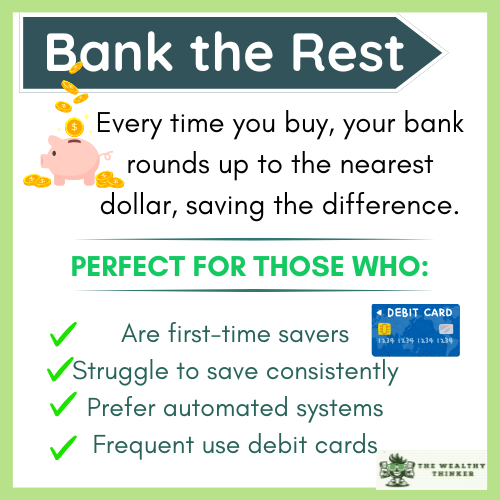
Think of them as a digital piggy bank – every time you make a purchase, your bank rounds up to the nearest dollar and saves the difference.
Sounds simple, right?
But is this modern spin on penny-saving actually worth your time?
Let’s break the value of the Bank the Rest program.
How Does “Bank the Rest” Work?
Here’s a simple example:
- You buy coffee for $4.25
- Your bank rounds it up to $5.00
- $0.75 automatically transfers to your savings account
These are small amounts, but they can add up. Let’s dig into the details.
Real Numbers: How Much Can You Actually Save?
Let’s calculate potential savings based on different spending habits:
Moderate Spender:
- 20 transactions per month
- Average round-up of $0.50 per transaction
- Monthly savings: $10
- Annual savings: $120
Heavy Card User:
- 40 transactions per month
- Average round-up of $0.50 per transaction
- Monthly savings: $20
- Annual savings: $240
Super Spender:
- 60 transactions per month
- Average round-up of $0.50 per transaction
- Monthly savings: $30
- Annual savings: $360
Popular Bank the Rest Programs and Their Features
Bank of America’s “Keep the Change”
- Rounds up debit card purchases
- Transfers difference to savings account
- No additional fees
- Must have both checking and savings accounts
- Works with multiple cards
- Invests your round-ups
- Monthly fee: $3-5
- Additional investment features
- Automatic round-ups
- No fees
- Includes other savings features
- Direct deposit required
Wells Fargo’s “Save As You Go”
- $1 transfer with each round-up
- No additional fees
- Requires both checking and savings accounts
Is Bank the Rest Better Than a High-Yield Savings Account?
Let’s Compare:
Round-Up Program:
- Average annual savings: $240
- Minimal effort required
- Automatic savings
- Usually, no interest earned
High-Yield Savings Account (2% APY):
- Requires manual deposits
- $240 annual deposit would earn $4.80 in interest
- Higher rates on larger balances
- More flexibility
The verdict?
Why not both? You can use round-up programs to automatically save and then periodically transfer the accumulated savings to a high-yield account.
Who Benefits Most?
This Program is Great For:
- First-time savers
- People who struggle to save consistently
- Those who prefer automated systems
- Frequent debit card users
Maybe Not For:
- Cash-only spenders
- Those who already have robust savings habits
- People who prefer manual money management
- Those with very few monthly transactions
Maximizing Your Round-Up Savings
Tips to Get More from the Program:
- Use your card for small purchases
- Don’t let it replace other savings methods
- Regularly check your accumulated savings
- Consider transferring to higher-yield accounts periodically
Hidden Benefits
Beyond the Savings:
- Builds saving habits unconsciously
- Provides a “set it and forget it” approach
- Creates a separate emergency fund
- Helps track spending patterns
Potential Drawbacks to Consider
Watch Out For:
- Monthly service fees (some programs)
- Minimum balance requirements
- Limited access to funds
- Potential overdraft if not monitoring closely
Making the Most of Round-Up Programs
Smart Strategies:
- Link to your most-used debit card
- Keep enough buffer in checking to avoid overdrafts
- Monitor savings progress monthly
- Set goals for your rounded-up savings
The Bottom Line
Is bank the rest worth it? Yes, but with caveats.
It’s best viewed as a supplement to your regular savings strategy, not your primary method. Think of it as finding money in your couch cushions – a nice bonus, but not your retirement plan.
The real value lies in:
- Building saving habits effortlessly
- Creating an additional emergency fund
- Saving money you likely won’t miss
- Automating good financial behavior
For best results:
- Choose a program with no fees
- Use it alongside other saving methods
- Monitor your progress regularly
- Transfer accumulated savings to higher-yield accounts
Remember, every penny counts when it comes to saving, and sometimes the best strategy is the one you’ll stick with consistently.
If rounding up your purchases helps you save money you wouldn’t otherwise, then it’s absolutely worth it!
Ready to start?
Check with your bank about their round-up program, or explore third-party apps that offer this feature. Just be sure to read the fine print and understand any fees or requirements before signing up.