


The Wealthy Thinker
  • Home
  • Finance Basics
  • Financial Planning
  • Investing
  • Debt
  • Dailies
    • Daily Financial Tips
    • Daily Financial Affirmation
  • Subscribe
No Result
View All Result
  • Home
  • Finance Basics
  • Financial Planning
  • Investing
  • Debt
  • Dailies
    • Daily Financial Tips
    • Daily Financial Affirmation
  • Subscribe
No Result
View All Result
The Wealthy Thinker
No Result
View All Result
Home Finance Basics

Emergency Fund: 4 Basic Tasks Will Help You Know How Much You Need

We all know we should have an Emergency Savings fund - but how much do we need - and what factors can help us to figure that out?

Sara by Sara
June 25, 2024
in Finance Basics
Reading Time: 6 mins read
1
Hands hold a stack of dollar bills on a white desk. An emergency fund is critical for financial planning. And it's not hard to get started.

Emergencies are bound to happen. Avoiding emergencies is hard, but you can prepare for them to the best of your abilities.

Most emergencies have some type of financial impact, from breaking your arm and paying the ER fee or needing to repair your roof due to a leak. Emergencies can be emotionally and physically draining, but they can also hurt your current finances if you don’t have any savings to pay for them.

An emergency fund can help prevent a financial burden – on top of everything else you have to do during an emergency. 
 

A cartoon of a jar with money in it and a label that says: Emergency Savings
We all know we should have an Emergency Savings fund – but how much do we need – and what factors can help us to figure that out?


What is an Emergency Fund? 

An emergency fund is exactly what it sounds like – it’s an amount of money you have saved for an emergency.

It can be used for several things, from covering the cost of rent, food, and transportation if you’ve lost your job to cover the cost of something you were not expecting.

Typically, an emergency fund is about three to six months of your monthly expenses. If you track your spending and know your Cost of Living number, then you should know exactly how much you’ll need for your fund.  


RelatedPosts

How to Use CD Laddering to Increase Returns on Your Savings

Split Direct Deposit: 5 Benefits to a Simple Savings Plan

Mediation: A Divorce Alternative That Won’t Leave You Broke?

Why do you need an Emergency Fund?

Having an emergency fund is crucial to having financial security.

Most financial experts will tell you to have one, but understanding why you need one can help motivate you to save three to six months of your monthly expenses. Some reasons may be extreme, such as a medical emergency, but other reasons are simply that you can feel at peace knowing you have some money set aside. 

The most important reason to have an emergency fund is if you lose your job. If you don’t have one, you may be unable to afford your essential monthly expenses.

In addition, having an emergency fund will be less stressful during this already stressful time. You can focus on finding a new job while knowing that your housing, food, and transportation needs are covered. 

An emergency fund can also help you stay out of debt. It can be used for any reason you need to pay for something that you cannot afford with your regular budget. Of course, you shouldn’t dip into your fund for all purchases, but it can assist in keeping you out of debt. 

Emergency funds are also great to use as a rainy day fund if you have an emergency expense, repair, or medical emergency come up. These things can be costly, and it’s good to know that if something happens, you can cover most or all of the expenses. Things happen, and it’s good to prepare for them. 


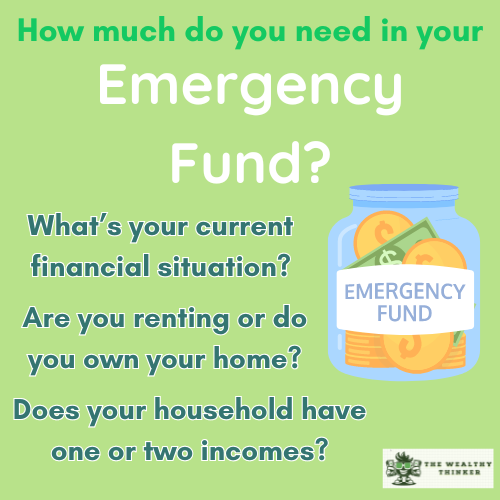
How much do you need in your Emergency Fund?

What stops many people from starting an emergency fund is that it can be challenging to know how much you need. Knowing that you need about three to six months is a start, but knowing if you need three or six months is the challenging part. 

The first thing you need to know when calculating how much you need to save is to understand your current financial situation.

Next, you need to:

  • track your spending
  • have a Cost of Living number
  • make a budget

Doing these three things will allow you to know exactly how much you would need for a one-month emergency fund. 

Next, evaluate your family status and level of risk.

Every household will be different, but there are some general rules.

If you are single or have a one-income household, it is best to save six months of expenses for an emergency fund. Should you lose your job, you are at a higher risk and don’t have additional financial support.

If you have a family with two incomes, save three months of expenses towards your emergency fund. With two incomes, you have more financial support if you lose your job. The one income should be able to support your life. 

You also need to decide if you have certain risks that may require you to tap into your emergency fund.

These risks can be owning a home. For example, you won’t have to pay for household repairs if you rent a house. On the other hand, if you own a home, you will have to pay for all repairs and upgrades. You may want an extra month or two if you can anticipate specific emergencies that may occur one day. 

Finally, plan how you will save up for your emergency fund.

You may decide to cut back on spending in certain areas and use that money towards your emergency fund. You may add this to a line of your budget until you finish building your fund.

It’s essential to make sure that you replenish your fund if you use it!


Final Thoughts

Emergency funds are more than a suggestion; they are crucial if you want to have financial security.

While saving three to six months of your expenses may seem like a significant amount of money, it can help you from:

  • going into debt
  • paying off emergency medical expenses
  • or covering your household spending while you are searching for a new job

It’s up to you how much you want your fund to be, but consider your household, income, and level of risks to determine how much to save. Then, start saving money monthly and putting it into your savings account for those rainy days. 

Photo by Karolina Grabowska

Tags: Beginnerfinancial securitysavings
Sara

Sara

Sara DeSantis is an Accredited Financial Counselor Candidate through the AFCPE and is an adjunct professor teaching personal financial literacy. She is passionate about teaching the basics of finance to young adults who are entering the adult world with debt. Sara is part of the FIRE movement and hopes to retire before 30. She has published dozens of finance articles for blogs, developed finance courses, and written over 50 financial podcast scripts. Sara resides in Denver, CO.

Related Posts

What not to do with money: these movie characters will help you learn quickly!
Finance Basics

4 Movie Characters Who Teach You What NOT to Do With Money

by Sara
October 6, 2024

One of the easiest ways to learn about personal finance is from experience. However, you probably don't want to learn...

Read moreDetails
We can learn surprising financial lessons from watching films and shows.

3 Pop Culture Icons Who Taught Us Surprising Financial Lessons

June 2, 2025
Man takes notes while reading financial literacy resources on a laptop.

10 Expert Financial Literacy Resources to Master Your Money

April 17, 2025
Our Best 4 Financial Takeaways from Watching Netflix’s “Money Explained”

Our Best 4 Financial Takeaways from Watching Netflix’s “Money Explained”

July 3, 2025
Get Smart With Money is a fantastic financial literacy documentary to help you learn about money.

4 Key Takeaways from Netflix’s “Get Smart With Money” 

December 4, 2025

Comments 1

  1. ANTOANETA DARRLEST says:
    3 years ago

    THANK YOU FOR YOUR FINANCIAL ADVISES -EVERY TIME READING THEM- I FEEL LIKE SOMEONE IS TALKING TO ME,ABOUT MY CURRENT FINANCIAL SITUATION AND NEW WAY TO GET STRONGER IN MY BELIEF- THAT- I SHALL NOT BECOME”RICH” BUT FOLLOWING YOUR ADVISES- I CAN BUILT UP A “RICH” AMOUNT OF MONEY-AS BEING MY PERMANENT FINANCIAL COVER -FOR DEMANDS OCCURING SUDENLY IN MY LIFE.

    Reply

Leave a Reply Cancel reply

Your email address will not be published. Required fields are marked *

  • Trending
  • Comments
  • Latest
Person sits on chair, holding wallet full of colorful gift cards.

4 Financial Services Loyalty Programs That Go Beyond Free Flights

December 3, 2025
A view from the driver's seat of a luxury Mercedes steering wheel. Adopting a rich mindset can make all the difference in your savings plans.

10 Rich Mindset Habits You Can Start Emulating Now

August 5, 2024
Stop wasting money on these 15 every day things!

15 Things You Need to Stop Wasting Money on Right Now

June 15, 2024
A few financial quotes can keep you focused on saving!

40 Financial Quotes to Help Keep You Motivated

February 21, 2025
Luxury vehicle parked in front of a modern mansion. Do you have a wealth mindset?

Wealth Mindset vs. Poverty Mindset: The Key to Developing a Wealth Mentality

A view from the driver's seat of a luxury Mercedes steering wheel. Adopting a rich mindset can make all the difference in your savings plans.

10 Rich Mindset Habits You Can Start Emulating Now

Stop wasting money on these 15 every day things!

15 Things You Need to Stop Wasting Money on Right Now

Everyone would like to be as successful as Warren Buffett, but few have his discipline.

How to Invest Like Warren Buffett

Orange envelope filled with cash beside a green festive gift box.

9 Meaningful Ways to Spend Your End-of-Year Bonus

December 12, 2025
Woman stands over man at computer in a bright office.

Mental Health, Cybersecurity & Analysis: 10 Fast-Growing Jobs in 2026

December 12, 2025
Hand holds a remote to a screen with streaming services.

Streaming Services Challenge: The 10-Step Smart Apps Audit to Get the Best Bang for Your Buck

December 8, 2025
Retail worker puts away clothes on a rack in a store.

12 Hot Tips for Holiday Shopping From an Actual Retail Worker

December 5, 2025

Today's Financial Message

December 12 2025

by The Wealthy Thinker Team
December 12, 2025

Remember when holiday bonuses were actual money, not a $25 gift card to a restaurant you'd never choose yourself?  ...

Read moreDetails

Join us at The Wealthy Thinker!

Welcome new reader! Join our newsletter for expert financial tips and make the most out of your money!

The Wealthy Thinker

© 2024 TheWealthyThinker.com

Navigate Site

  • Contact Us
  • About Us
  • Glossary Terms
  • Privacy Policy
  • Site Terms

Follow Us

Join us at The Wealthy Thinker!

Even the rich and famous have money mishaps.

Welcome new reader! Join our newsletter for expert financial tips and make the most out of your money.

No Result
View All Result
  • Home
  • Finance Basics
  • Financial Planning
  • Investing
  • Debt
  • Daily Financial Tips
  • Daily Financial Affirmation

© 2024 TheWealthyThinker.com