



The Wealthy Thinker
  • Home
  • Finance Basics
  • Financial Planning
  • Investing
  • Debt
  • Dailies
    • Daily Financial Tips
    • Daily Financial Affirmation
  • Subscribe
No Result
View All Result
  • Home
  • Finance Basics
  • Financial Planning
  • Investing
  • Debt
  • Dailies
    • Daily Financial Tips
    • Daily Financial Affirmation
  • Subscribe
No Result
View All Result
The Wealthy Thinker
No Result
View All Result
Home Debt

How the Debt Snowball Method Can Help You Knock Your Debt Out

Start small and roll your way to the biggest debt.

Sara by Sara
April 7, 2025
in Debt
Reading Time: 5 mins read
0
Someone holds a debt snowball in her mittens.

There are a few systems to pay off debt – and one of the most popular is the Debt Snowball method.

This method helps you get into the habit of paying off your debt and seeing quick success by first paying off your smallest debts.

This allows you to free up some income to tackle those larger debts. It’s a method that has worked for a lot of people. 
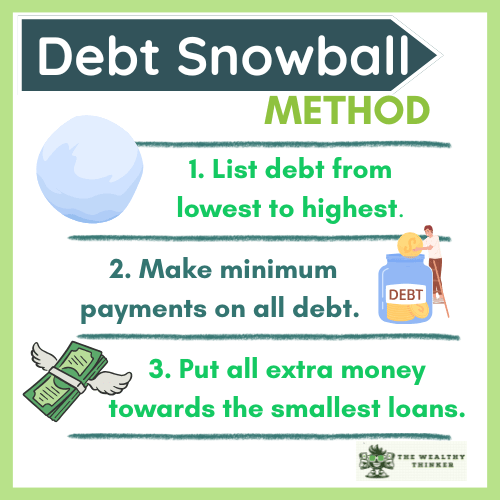
 

Graphic with images and text related to the topic of the debt snowball method


What is the debt snowball, and how does it work? 

The debt snowball is a strategy to pay off your debt.

This is accomplished by paying off your debts from the smallest to largest. Doing this will allow you to gain some momentum to get rid of each loan.

RelatedPosts

Is Debt Consolidation Right For You? 5 Hard Truths You Need to Face

Paying off the smallest debt allows you to build that momentum. For example, it’s easier to tackle a $1,000 loan over a total of $40,000 of debt. When you pay off the $1,000 loan, that minimum payment then rolls into the next smallest debt.

This continues and frees up your income to tackle those larger debts even faster. 


How to get started with the debt snowball method? 

The first step in starting the debt snowball method is to list all of your debts from smallest to largest.

Don’t worry about interest rates. This method does not tackle the loan with the highest rate. 


The next step is to continue to make just minimum payments on all debts except for the smallest debt.

You want to continue to have a good status on your other debts and not ignore them. You don’t want to hurt your credit score or have collections calling you. 


The next step is to put anything extra onto the smallest debt in addition to the minimum payments.

To do this, you will have to budget.

You need to know your current spending and really look at what you can cut out. Then,

  • lower your expenses
  • cut spending
  • sell unused things in your home
  • find a side hustle

All of this extra money will go towards your debt. You’ll keep doing this extra work and reducing your expenses until all of your debt is paid off. 


Finally, repeat this process for all of your debts.

After your first smallest debt is paid off, all of your extra savings from reducing spending and side hustles, as well as that previous debt’s minimum payments, will go towards the second debt.

And then when that is done, that money you put toward that debt and the second debt minimum payments will go to the next. 

The goal is by the time you are at the largest debt; you are used to extreme saving, side hustling, and paying off debt that you will pay off a huge amount of debt in a record amount of time. 


An Example of the Debt Snowball Method

To really understand this method, it’s helpful to see this in action. We will use four debts as an example. 

Step 1 – List debt from lowest to highest 

  • Debt 1 – $1,000 Medical Bill ($100/month payment) 
  • Debt 2 – $5,000 credit card debt ($120/month payment)
  • Debt 3 – $10,000 Car loan ($250/month payment) 
  • Debt 4 – $20,000 student loans ($200/month payment) 


Step 2 – Make minimum payments on all debt 

Your total monthly payments will add up to $670/month for your debts. 


Step 3 – Put all extra money towards the smallest loans

If you know how much you spend and save a month, you should have a clear idea of how much it will take you to save $1,000.


Let’s say you can save $500 a month towards debt. This means that you will have paid off your first debt in two months! 

Your monthly savings are $500 plus $100 (from the monthly payments on Debt 1) for a total of $600/month. 

With this knowledge, you know it will take you around eight months to pay off your second debt. 

After eight months, you’ll then be able to save $720 a month to tackle your third debt. Then, you will have that third debt paid off in about one year. 

Finally, it’s time to tackle your final debt! You will save $880/month towards your final debt. This will take you about two years to finish this loan. 

The entire debt snowball took about four years in total to finish paying off all of your loans. 


Are You Ready to Try the Debt Snowball Method? 

The great thing about this plan is that if you are able to increase your savings, you can pay off your debt faster.

For example, if you are able to save $1,000 a month, you can pay off the first loan in one month.

The second loan in 4.5 months, the third in 8 months, and the fourth in 13 months! Then all of the money you’ve been saving can be used towards reaching your other financial goals.

Editor’s note: This article was originally published Jan 17, 2024 and has been updated to improve reader experience.


Photo by Yan Krukau

Tags: debt planning
Sara

Sara

Sara DeSantis is an Accredited Financial Counselor Candidate through the AFCPE and is an adjunct professor teaching personal financial literacy. She is passionate about teaching the basics of finance to young adults who are entering the adult world with debt. Sara is part of the FIRE movement and hopes to retire before 30. She has published dozens of finance articles for blogs, developed finance courses, and written over 50 financial podcast scripts. Sara resides in Denver, CO.

Related Posts

Person puts coins in a jar marked SAVE. You can maximize your money with every decision.
Debt

Maximize Your Money: 15 Tips to Unlock a More Frugal Mindset

by Susan
June 19, 2025

Listen, people are touchy about money. We don't like to talk about it and especially not when we're worried we...

Read moreDetails
Man counts money at a brown desk.

5 Smart Tips to Avoid Being House Poor & 7 Strategic Ways to Get Out

November 19, 2025
Two men sit together having the money talk.

Having ‘The Money Talk’: 6 Critical Topics to Hit With Your Partner

November 7, 2025
Attentive man sits in business meeting

5 Common Money Mistakes That Will Cost You Big Time

November 6, 2025
Managing your debt means you won't be holding an empty wallet any more.

9 Signs You Need Help Managing Your Debt & 3 Ways to Handle it

July 26, 2025

Leave a Reply Cancel reply

Your email address will not be published. Required fields are marked *

  • Trending
  • Comments
  • Latest
Person sits on chair, holding wallet full of colorful gift cards.

4 Financial Services Loyalty Programs That Go Beyond Free Flights

December 3, 2025
A view from the driver's seat of a luxury Mercedes steering wheel. Adopting a rich mindset can make all the difference in your savings plans.

10 Rich Mindset Habits You Can Start Emulating Now

August 5, 2024
Stop wasting money on these 15 every day things!

15 Things You Need to Stop Wasting Money on Right Now

December 24, 2025
A few financial quotes can keep you focused on saving!

40 Financial Quotes to Help Keep You Motivated

February 21, 2025
Luxury vehicle parked in front of a modern mansion. Do you have a wealth mindset?

Wealth Mindset vs. Poverty Mindset: The Key to Developing a Wealth Mentality

A view from the driver's seat of a luxury Mercedes steering wheel. Adopting a rich mindset can make all the difference in your savings plans.

10 Rich Mindset Habits You Can Start Emulating Now

Stop wasting money on these 15 every day things!

15 Things You Need to Stop Wasting Money on Right Now

Everyone would like to be as successful as Warren Buffett, but few have his discipline.

How to Invest Like Warren Buffett

Man and woman sit on floor amid moving boxes.

The 5 Most Affordable Cities in the U.S. in 2026

January 26, 2026
Man pulls cards out of a brown wallet.

The 5 Best Balance Transfer Cards to Get Ahead of Debt in 2026

January 23, 2026
Overwhelmed man sits across desk from financial advisor.

3 Totally Achievable Financial Goals for Gen X in 2026

January 21, 2026
Stacks of gold coins with an arrow traveling up.

The 5 Best High-Yield Savings Account Rates in January 2026

January 2, 2026

Today's Financial Message

January 28 2026

by The Wealthy Thinker Team
January 28, 2026

Back in the day, you could spend three hours trying to hook up your Nintendo to the old TV with...

Read moreDetails

Join us at The Wealthy Thinker!

Welcome new reader! Join our newsletter for expert financial tips and make the most out of your money!

The Wealthy Thinker

© 2024 TheWealthyThinker.com

Navigate Site

  • Contact Us
  • About Us
  • Glossary Terms
  • Privacy Policy
  • Site Terms

Follow Us

Join us at The Wealthy Thinker!

Even the rich and famous have money mishaps.

Welcome new reader! Join our newsletter for expert financial tips and make the most out of your money.

No Result
View All Result
  • Home
  • Finance Basics
  • Financial Planning
  • Investing
  • Debt
  • Daily Financial Tips
  • Daily Financial Affirmation

© 2024 TheWealthyThinker.com