



When making an investment, one of the biggest questions is deciding which type of asset to choose.
Picking the right one means understanding each option’s unique qualities and whether it fits your goals.
Some assets share similar traits, while others are quite different, even behaving in opposite ways. Exchange-traded funds (ETFs) and index funds are both popular choices for investors wanting to get into the stock market.
However, these two types of funds can often be confused.
Many investors assume they’re the same, but they have key differences. This article will clarify the similarities and differences between index funds vs ETFs, helping you understand when each might be the right choice to meet your financial goals.
What are Index funds?
An index fund is a type of mutual fund that’s designed to track the performance of an index such as the S&P 500, Dow Jones Industrial Average, Russell 2000, or Nasdaq. It is an easy way to buy the whole market or a sector. Rather than rummaging through a long list of stocks to find a suitable one to invest in, you can invest in index funds.
Investing in index funds is a hands-off passive investment strategy for investors hoping to build a diversified portfolio.
Investors in index funds don’t try to beat the market, but rather aim to replicate the performance of the market.
What Are Exchange-Traded Funds?
An exchange-traded fund contains a basket of stocks that are traded like one security.
An ETF may be composed of different stocks. Rather than invest in each individual stock, the investor invests in the ETF.
Wondering About ETFs? The Top 10 Questions About Exchange Traded Funds Answered
Similarities Between Index Funds vs ETFs.
Basket of securities
ETFs and index funds share many similarities.
Firstly, both investment vehicles lump different securities together into a single financial product (fund) in which people can invest. This allows investors to take advantage of market volatility and benefit from the price movement of these securities without owning them directly.
Diversification
Secondly, they offer investors a diversified portfolio because they contain different securities. For example, an ETF or index fund which tracks the Nasdaq would offer the investor exposure to stocks in that index which are mostly technology based.
Lower management cost
Because the securities are lumped into one investable financial product which is managed passively, the management fees are usually lower than when dealing with individual securities or actively managed funds like mutual funds where a broker readjusts the portfolio of securities frequently.
Long-term returns
Investments are passively managed; they tend to have stronger long-term returns than funds that are actively managed which perform better in the short term. The Stock market has historically shown positive returns. For example, in the last 10 years, the average return of the S&P 500 is 12.39%.
Actively managed funds perform better in the short term because fund managers make investment decisions based on current market conditions and the fund composite accordingly. However, the probability of posting consistent, market-beating decisions over a long period can lead to lower returns over time.
The differences between index funds vs ETFs
Trading pattern
The major distinction between index funds vs ETFs is the way they are traded.
- Index funds are traded based on the price set at the end of the trading day, i.e. after the market has closed.
- ETFs on the other hand trade much like stocks and can be bought and sold when the market is in session.
The minimum start-up investment
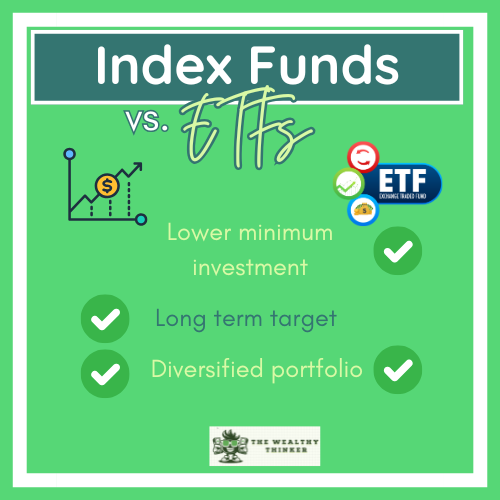
ETFs require a lower minimum investment than index funds.
All it takes is buying one share of an ETF. Some brokers offer fractional shares to investors on their platform which means investors can buy in amounts below the price of one share unit.
On the contrary, index funds require a minimum amount before one can invest in them which can be higher than a typical share price. As an example, you need to have a minimum investment of $3,000 to invest in Vanguard Index funds.
Tax efficiency
ETFs are generally more tax-efficient than index funds.
When you sell an ETF, you are selling directly to another investor. Capital gains taxes (a tax paid by the investor when they sell an asset) accrued from the trade are yours alone to pay.
However, when you sell an index fund, you are redeeming it from the fund manager, who has to sell securities to raise the cash to pay you.
If this is a profitable trade, the net gains are passed on to every investor with shares in the fund. This implies that you can owe capital gains taxes on your index funds without ever selling a single share.
Price
As such, you can’t really choose an entry or exit price for an index fund because you have no control over the closing price.
This contrasts with ETFs where you can determine your entry and exit points because you are trading real-time during the market’s session.
When are ETFs good for you?
If you are a trader with a short-term investment target, then ETFs can be a good choice for you.
This is because they trade like stocks, allowing traders to take advantage of market volatility and price movements. ETFs trade intraday, like stocks. This can be an advantage if you’re able to take advantage of price movements that occur during the day.
If you also have little investable capital, you can invest in ETFs since you can chase fractional shares.
When are Index Funds good for you?
Investing in index funds is for those who want to put their money to work and chill.
This means you pay no attention to market volatility and price movements. Also, if you have a large lump of cash but are unsure and are risk-averse, then index funds are a good bet for you.
If you’re investing in major projects such as your child’s education, your retirement, or for a new house, index funds are a good option for you. Since your major target is tracking an index, you just need to look at the historical performance and see if it is the right investment for you.
Index Funds vs ETFs: The Bottom Line
When comparing index funds vs ETFs, many investors make the mistake of thinking in terms of, “which is better?”
The correct approach to this is, “which one suits my investment purpose?”
Both simplify the decisions an investor has to make by offering a basket of securities lumped into one investable financial product.
They’re also passive ways to invest, though some ETFs are actively managed.
However, ETFs offer:
- lower expense ratios
- greater flexibility
- and enable investors to take advantage of short-term market volatility by moving in and out of positions
They are also more tax-efficient and do not require a minimum amount before you can invest in them.
This contrasts to index funds which require minimum amounts and have the possibility for increasing capital gains tax for investors.
An understanding of both assets in view of your investment objective enables you to make the right decisions when it comes to choosing which one to invest in. alternatively, you may choose to invest in both to offer diversification and reduce overall risk to your portfolio.
Editor’s note: This article was originally published Sep 6, 2021 and has been updated to improve reader experience.
Photo by Kelly Sikkema on Unsplash