



What’s the best choice when it comes to renting vs owning a home?
Homeownership is a more elusive goal than it once was. However, it’s a goal that most of us still have in mind. Of course, to buy a home and pay a mortgage is to build equity, which is objectively better than paying someone else’s mortgage.
But buying a home isn’t always the better alternative to renting. There are multiple financial considerations that should go into the biggest financial decision you’ll probably make in your life.
In this article, we will look into:
- The financial responsibilities of renting vs buying a home
- Pros and cons of rent vs buy
- The finer details of homeownership
- The “rent to own” phenomenon
Renting vs Owning a Home: Your Complete Guide for 2025
Making the decision between renting and buying a home is one of the most significant financial choices you’ll face.
With current market conditions showing median home prices at $414,000 as of April 2025 according to the National Association of Realtors, understanding the full picture is more important than ever.
The Real Cost Comparison: What You’ll Actually Pay
Current Market Reality
The numbers tell a stark story about today’s housing market. According to U.S. News analysis, the total cost of owning a median-priced single-family home is nearly $3,800 per month, compared to $2,236 for renting a typical single-family home—making renting about 30% less expensive.
Here’s what drives these costs:
Monthly Ownership Costs (Beyond Your Mortgage):
- Property taxes: $200-800+ monthly (varies by location)
- Homeowner’s insurance: $100-300 monthly
- Maintenance and repairs: $200-500 monthly average
- Utilities (water, sewer, trash): $100-200 monthly
- HOA fees: $50-400+ monthly (if applicable)
Monthly Rental Costs:
- Studio apartments: median $1,384 (projected 5.9% increase in 2025)
- One-bedroom units: projected 5.3% increase in 2025
- Renter’s insurance: $15-30 monthly
- Some utilities (typically included or shared)
The Benefits of Buying: Building Your Financial Future
Equity: Your Money Working for You
When you buy a home, each mortgage payment builds equity—essentially forced savings that renters don’t get. Over time, this creates several powerful advantages:
Financial Leverage and Stability:
- Access to better loan rates for future purchases
- Ability to borrow against your home’s value through home equity loans
- Protection against rent increases and displacement
- Potential tax benefits through mortgage interest deductions
Long-term Wealth Building: Even with home prices having increased 50% between 2019 and 2024, homeownership remains a key wealth-building strategy. Your monthly housing payment becomes an investment rather than pure expense.
Control and Stability:
- Renovate and customize your space
- No risk of sudden lease termination
- Predictable housing costs (fixed-rate mortgages)
- Multi-generational living options
The Hidden Costs of Homeownership
Upfront Expenses
Beyond the down payment, expect these immediate costs:
- Closing costs: 2-5% of home price ($8,000-20,000 on a $400,000 home)
- Home inspection: $300-500
- Appraisal: $300-600
- Moving expenses: $800-2,500
Ongoing Responsibilities
Homeownership means you’re responsible for everything that breaks. Major expenses can include:
- Roof replacement: $8,000-15,000
- HVAC system: $3,000-10,000
- Plumbing emergencies: $500-3,000+
- Appliance replacements: $500-2,000 each
Current Market Conditions: What to Expect
Mortgage Rates
According to U.S. News analysis of economists’ projections, 30-year fixed mortgage rates are expected to stay between 6.5% and 7% through 2025, significantly higher than the 3-4% rates seen in recent years.
Bankrate forecasts rates to settle around 6.5% by the end of 2025, while some economists expect rates to remain elevated throughout the year.
Rental Market Trends
Rent growth is expected to match historical averages of around 3.5% for the latter half of 2024 and continue into 2025. This means steady but manageable increases for most renters.
When Renting Makes More Sense
Flexibility and Lower Risk
Renting is often better if you:
- Plan to move within 5 years
- Work in a volatile industry
- Prefer predictable monthly expenses
- Want to invest your down payment money elsewhere
- Value maintenance-free living
Financial Breathing Room
With renting typically costing 30% less monthly, you have more money available for:
- Emergency savings
- Retirement contributions
- Investment opportunities
- Travel and experiences
When Buying Makes More Sense
Long-term Stability
Buying typically works better if you:
- Plan to stay 7+ years in the same area
- Have stable income and employment
- Want to build long-term wealth
- Prefer control over your living space
- Have sufficient emergency savings after the down payment
The Third Option: Rent-to-Own
Rent-to-own agreements offer a middle path but come with important considerations:
How It Works:
- You sign a standard lease with an option to purchase
- Part of your rent may credit toward future purchase price
- Set purchase price agreed upon upfront
- No obligation to buy (unlike lease-purchase contracts)
Potential Benefits:
- Time to improve your credit score
- Lock in today’s purchase price
- You can test the neighborhood before committing
Potential Drawbacks:
- Higher monthly rent than typical rentals
- You risk losing rent credits if you don’t buy
- You may be responsible for maintenance costs
- Limited legal protections
Making Your Decision: 5 Key Questions to Ask
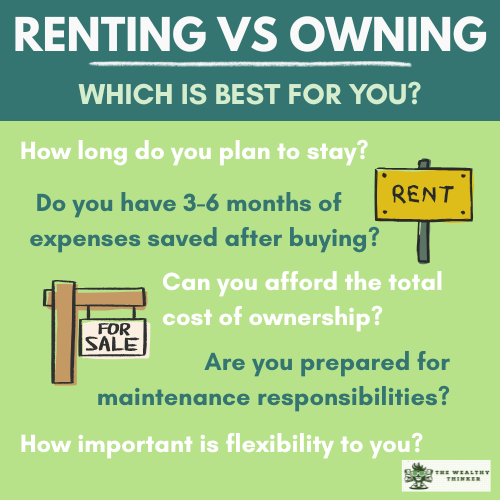
- How long do you plan to stay? The longer you stay, the more buying makes sense financially.
- Can you afford the total cost of ownership? Remember, it’s not just the mortgage payment.
- Do you have 3-6 months of expenses saved after buying? Emergency funds are crucial for homeowners.
- Are you prepared for maintenance responsibilities? From clogged drains to roof leaks, it’s all on you.
- How important is flexibility to you? Selling a home takes time and money.
Renting vs Owning a Home: The Bottom Line
In 2025’s market, renting often makes more financial sense in the short term, especially with ownership costs running about 30% higher than renting.
However, buying remains a powerful long-term wealth-building strategy for those who can afford it and plan to stay put.
The “right” choice depends entirely on your personal financial situation, life goals, and risk tolerance. Consider speaking with a financial advisor to run the numbers based on your specific circumstances and local market conditions.
Sources and References:
Home Price Data:
- Bankrate Housing Market 2025 Forecast – National Association of Realtors median home price data
- The Motley Fool Average House Price by State 2025 – Q1 2025 median house price
- U.S. Census Bureau New Residential Sales – New home sales data
Market Analysis:
- U.S. News Housing Market Predictions – Total homeownership costs vs. rental costs comparison
Mortgage Rate Forecasts:
- U.S. News 2025 Mortgage Rate Forecast – Economist projections for 6.5%-7% range
- Bankrate Mortgage Rate Forecast – 6.5% year-end projection
- Yahoo Finance Mortgage Rate Analysis – 2025 rate ranges
Editor’s note: This article was originally published Apr 14, 2022 and has been updated to improve reader experience.















Having a home is great, but it’s not good when you continue to change situations. I like to be clear of debt when I am clear of my situation. Debt means you are responsible for the debts, so I do things according to what I have and get.
Smart advice Donna, thank you!