


Your smartphone screen cracks, your laptop battery fails, or your refrigerator stops cooling. (Hopefully, not all on the same day.)
Not long ago, the default response would have been “time for a new one.” But a growing movement is challenging this replace-rather-than-repair mentality, and adopting its principles could transform your financial future.
How Repairing Saves You Real Money: Fix It, Don’t Ditch It
Understanding the Right to Repair Movement
The Right to Repair movement emerged as a response to manufacturers increasingly designing products that are difficult or impossible for consumers to fix themselves.
From smartphones with glued-in batteries to tractors with software locks, companies have created barriers to independent repairs through design choices, restricted access to parts, and proprietary tools.
This movement advocates for legislation requiring manufacturers to:
- provide repair manuals
- make spare parts available
- design products that can be reasonably fixed
It’s fundamentally about consumer choice – the right to fix what you own rather than being forced into costly replacements.
While the political movement focuses on legislative change, its underlying philosophy offers a powerful framework for personal finance.
10 Household DIY Projects That Can Save You Big Time
The Financial Power of a Repair-First Mindset
A ‘repairing saves’ approach creates multiple financial benefits that compound over time:
Immediate Savings
The math is often striking.
Replacing a broken refrigerator might cost $1,200-2,500, while a repair typically runs $200-400.
A new smartphone easily costs $800-1,200, whereas a screen replacement might be $100-300.
Even accounting for the eventual need for replacement, extending a product’s life through repairs typically delivers substantial net savings.
These savings aren’t just one-time benefits. They represent money that can be redirected to emergency funds, debt reduction, or investments, creating long-term financial advantages.
Reduced Consumer Debt
Many replacements end up on credit cards because they’re unexpected expenses.
According to the Federal Reserve, the average American household carries about $6,270 in credit card debt, with much of it stemming from “necessary” purchases when things break.
By repairing instead of replacing, you avoid accumulating high-interest debt that can linger for years.
A $1,500 appliance purchase that goes on a credit card at 18% interest and receives only minimum payments could ultimately cost over $3,000 with interest.
Building Wealth Through Opportunity Cost
Perhaps the most powerful financial benefit comes from opportunity cost – what your money could earn if not spent on replacements.
Consider this example:
Imagine you repair rather than replace items over 10 years, saving $5,000 in the process.
If you invested that money in a basic index fund earning an average 7% annual return, you’d have about $9,836 after those 10 years.
Extended over 30 years, those same savings would grow to over $38,000.
This illustrates a fundamental principle of wealth-building: It’s not just what you save, but what those savings can earn over time.
Developing Repair-First Habits
Adopting a repair-first mindset involves more than just good intentions. Here’s how to make it a practical financial strategy:
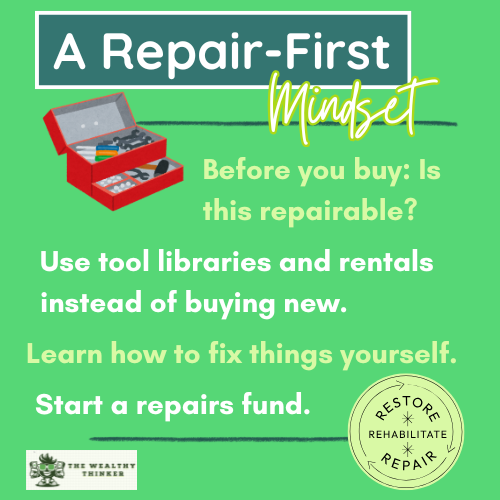
Assess Repairability Before Purchasing
Start by researching how repairable items are before buying them.
Organizations like iFixit provide “repairability scores” for electronics, while online forums can offer insights into the longevity and fixability of appliances.
Look for products with:
- Available repair manuals
- Reasonably priced replacement parts
- Designs that allow access to common failure points
- Strong community support for DIY repairs
Paying slightly more upfront for repairable items often delivers significant long-term savings.
Build a Repair Fund
Just as you might have an emergency fund for unexpected expenses, consider creating a specific repair fund.
Setting aside small amounts regularly creates a financial buffer that helps you avoid the “I can’t afford to repair it” trap that leads to putting replacements on credit cards.
A repair fund of even $300-500 can cover many common fixes, preventing small problems from becoming financial emergencies.
Learn Basic Repair Skills
You don’t need to become an expert technician, but learning basic repair skills pays significant dividends. Start with simple tasks:
- Replacing smartphone screens
- Upgrading computer RAM or storage
- Fixing leaky faucets
- Patching clothing
- Basic appliance maintenance
Online tutorials make learning these skills more accessible than ever.
Websites like iFixit, YouTube channels focused on repairs, and manufacturer service manuals provide step-by-step guidance for thousands of common repairs.
Access Tools Without the Investment
One barrier to DIY repairs is the specialized tools they sometimes require.
Rather than purchasing expensive tools you’ll rarely use, consider these alternatives:
- Tool libraries: Many communities now have lending libraries specifically for tools, allowing you to borrow what you need for specific repairs.
- Tool rental: Home improvement stores often rent specialized tools for a fraction of their purchase price.
- Community workshops: Makerspaces and community workshops provide access to tools and expertise, often for nominal membership fees.
- Neighbor sharing: Apps like NextDoor make it easier than ever to borrow tools from neighbors, creating community connections in the process.
These options transform what might be a prohibitive upfront cost into an affordable solution.
When to Repair vs. When to Replace
A repair-first mindset doesn’t mean repairing everything regardless of circumstances. Consider these factors when deciding:
- The 50% rule: If a repair costs more than 50% of a new item’s price, replacement might make more sense, especially for older items.
- Energy efficiency: Sometimes newer appliances offer significant energy savings that offset their cost over time.
- Safety concerns: Some repairs, particularly involving gas appliances or electrical systems, may raise safety issues that favor replacement.
- Frequency of repairs: If you’re facing the third repair in a short timeframe, the item might be reaching the end of its useful life.
The goal isn’t to repair at all costs, but to make conscious decisions rather than defaulting to replacement.
The Broader Impact
Beyond personal financial benefits, a repair-first approach creates positive ripple effects:
- Environmental sustainability through reduced waste
- Support for local repair businesses and jobs
- Reduced resource extraction and manufacturing impacts
- Community building through skill-sharing and tool exchanges
These benefits align financial self-interest with broader social and environmental good – a rare win-win in personal finance.
Repairing Saves You Money in More Ways Than One
The Right to Repair movement reminds us that we should have the option to fix what we own. By embracing this philosophy as a financial strategy, we:
- create immediate savings
- reduce debt
- establish habits that support long-term wealth building
In a culture that constantly pushes us toward the newest model or latest upgrade, choosing repair over replacement is a quietly revolutionary act – one that builds financial resilience while changing our relationship with the things we own.
The next time something breaks, pause before automatically reaching for your credit card to buy a replacement.
Ask instead: “Could this be repaired?” Your current and future financial self will thank you.