



Ever feel like your favorite snacks are disappearing faster than they used to?
You’re not imagining things. That sneaky phenomenon is called shrinkflation – when companies reduce the size or quality of a product but keep the price the same (or even raise it).
It’s like inflation in disguise, and it’s happening right under your nose.
Instead of raising prices and risking customer backlash, many brands quietly trim the product down:
- less cereal in the box
- fewer sheets in the roll
- smaller bars of soap
It’s a subtle trick that hits your budget without ringing any alarms.
In this article, we’ll break down:
- what shrinkflation is
- why it’s happening more than ever
- how to spot it before it eats into your finances
You’ll also get smart strategies to fight back and shop smarter in a world where more often means less. Let’s decode the fine print.
What is Shrinkflation?
Shrinkflation also known as the grocery shrink ray, deflation or package downsizing.
It is the practice by which companies reduce the size or quantity of a product while the price of the product remains the same or slightly increased.
In some cases, the term may indicate lowering the quality of a product or its ingredients while the price remains the same.
The term was coined by economist Pippa Malmgren in 2009 by combining the words ‘shrink’ and ‘inflation’. This hidden form of inflation is quite common in the food and beverage industry, though it has been observed in other industries as well.
Prices stay the same, but sizes are reduced.
Rather than increase the price of a product, a move that could backfire on the brand and affect sales negatively, producers reduce the size of the product while maintaining the same price.
The absolute price of the product doesn’t go up, but the price per unit of weight or volume has increased. The small reduction in quantity is usually unnoticed by consumers (at least that’s what the manufacturer hopes).
Shrinkflation is difficult to spot because stores usually clear out old products before replacing them.
Food brands, under the guise of rebranding their packages, reduce the size so consumers don’t notice the changes to the contents therein. The change in packaging does the job of deflecting the consumers’ attention to the package itself, rather than the contents. So most times, the changes go unnoticed.
The irony is that, under the law, shrinkflation is not viewed as fraud or misrepresentation of products.
This is because producers always indicate the weight, volume, or quantity of their products on packaging labels, knowing full well that consumers hardly check the fine print on these items.
As such, shrinkflation may not be illegal – it’s just sneaky.
4 Examples of Shrinkflation
Most food brands – if not all, have engaged in shrinkflation.
Even some of the most famous companies and brands have adopted these measures to keep shoppers loyal to their brands despite rising costs.
Data released by LendingTree reveals a long list of products that fall under the shrinkflation banner. They compared prices in 2019/2020 to those in 2024.
- Bounty Select-a-Size Paper Towels 8 Triple Rolls shrunk in size by 18.2% but increased in price by 36.4% per 100 count
- Party Size Cheetos reduced their size from 17.5 oz. to 15 oz. but increased their price per oz. from 17 cents to 40 cents – that’s an increase of 135.3% per ounce!
- Of the 16 types of cereal they analyzed, 7 of them (43.8%) downsized between 2019/20 and 2024
- About 38% of the candy items they researched are now sold in smaller amounts, including party size Reese’s miniatures, peanut M & M’s and milk chocolate Kisses
With the way food prices have been going, we should expect that this trend will continue, despite more and more consumers and news sources calling out the big manufacturers.
Already, companies are citing inflation as the biggest risk to their bottom line. Many of these companies will find ingenious ways to pass the costs to consumers without offsetting them.
3 Reasons Shrinkflation Happens
1. Rising overhead costs.
When bottom lines are being pinched, food companies are left with three options – raise the price directly, take a little bit out of the product, or reformulate the product with cheaper ingredients.
The main objective of a company is to make profit. As such, when overhead costs rise, companies have to pass these costs to the consumer to keep afloat.
2. Intense market competition.
Shrinkflation can also be caused by fierce aggressive competition.
Consumers have access to a plethora of viable replacements, which renders the food and beverage business intensely competitive.
With many companies operating at razor-sharp margins and high volume to keep afloat, a price change could mean falling down the pecking order of shoppers.
As a result, companies use shrinkflation because it allows them to retain their consumers’ trust while still maintaining their profit margins.
3. It is more profitable.
While CPG companies like to portray themselves as being customer-centric and reluctant to pass costs to consumers, the reality is that shrinkflation presents an ample opportunity for them to shore up their profit margins.
A Mortimer’s research found that shrinkflation led to a 38% increase in sales when product size was reduced along with prices.
This is because buyers felt they were getting a bargain because of the price reduction. By reducing contents, food brands can charge you more per unit.
After all, how many shoppers care to measure the total grams per cost to find the unit cost?
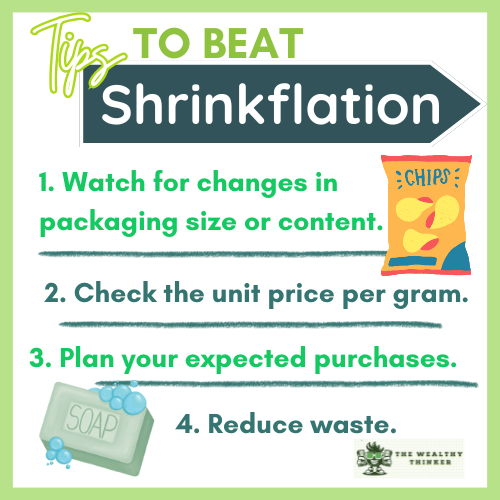
4 Ways to Beat Shrinkflation
1. Look out for changes in packaging size or content.
Shoppers tend to be price-sensitive, but they may not notice subtle changes in packaging or read the fine print on the size or weight of a product.
The result is that consumers are less likely to notice getting less if the price is the same. As such, it is critical that you pay more attention to changes in packaging size and content.
Any time that a company is repackaging their product, chances are that they are also reducing the content.
2. Check the unit price per gram.
Shoppers tend to focus more on the product price rather than the unit price.
- Product price is the amount you pay for the package or item.
- Unit price is the price you get per unit, gram, liter, sheet, or whatever the item is.
This is where you know if you are paying more or less.
If a company reduces its consent or quality, then there is a very strong possibility that you are being charged more. The price tag of the item is only nominal. The real value is in the price per unit.
3. Time your expected purchases.
Consumers are typically advised to have cash and emergency savings on hand in case of unanticipated expenses such as a house or car repairs, or even medical expenditures.
Pre-purchasing items on sale and in advance is another way to put your money to work. While this only applies to nonperishables, there is a real benefit to purchasing products at a reasonable price and in sufficient quantities.
Households might generate returns on their working capital well above 20% by buying intelligently and managing their stocks properly. The goal is to avoid stockpiling too much at full price and just buying when the price is appropriate.
4. Reduce waste.
Each day in the United States approximately one pound of food per person is wasted. According to the US Department of Agriculture, this translates to 103 million tons (206 billion pounds) of food waste created in America in 2017 or 30-40% of the food supply (USDA).
Food waste in the United States is estimated to be worth $161 billion per year, with the average American household of four wasting $1,500 per year. If such an amount of food that is trashed can be saved, this would have a significant financial impact on consumers’ spending and savings.
Food Waste: Why Are You Burning Money?→
Editor’s note: This article was originally published Apr 22, 2024 and has been updated to reflect economic changes.
















Very useful write-ups
Thank you