



The word “diversification” is thrown around a lot in finance.
Self-directed individual investors (Those who choose their own investments) are urged to diversify their investment portfolios to reduce risk.
But what exactly that means, and why “diversification” is considered common sense deserves some explanation.
Diversification is an investment technique that aims to reduce risk by spreading investment funds over a larger range of industries, types of financial assets, and oftentimes other categories.
In this article, we will cover:
- Why you should diversify your portfolio
- What diversification looks like
- Types of diversification
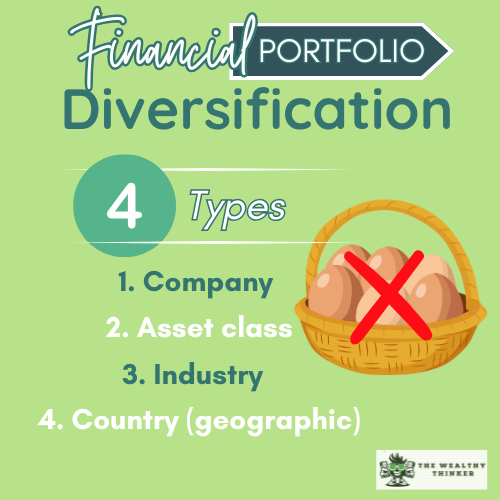
Table of Contents:
- Why should I diversify my portfolio?
- What is an example of a diversified portfolio?
- 4 Types of Portfolio Diversification
- 3 Factors to Consider When Diversifying
- Conclusion: Why Portfolio Diversification Matters
Why should I diversify my portfolio?
You should diversify your portfolio to reduce its overall risk.
Investing in a more diverse range of securities serves to minimize your losses.
If, for example, you are invested entirely in just one company, what happens if that company has a serious downturn or declares bankruptcy? Well, you might be finished investing is what!
Portfolio diversification is a way of protecting the value of your assets and preventing them from being too exposed to a particular sector which increases risk and potential losses. It is a way of balancing risk and reward in your investments.
“Don’t put all your eggs in one basket.”
Diversification means more than just that, however. Everyone understands this basic explanation of why you shouldn’t “put all your eggs in one basket”. But most financial advisors would advise you to diversify in terms of:
- Individual stocks
- Types of securities
- Industries
- More
There are good reasons for this.
For example, on the industry level, how much better is it to be invested in 20 oil companies versus one oil company during an oil crash? It’s certainly better, but you can still be sure your oil-soaked portfolio will suffer for it.
This may be a stereotypical example, but it’s still one that makes a clear point. Similar examples could be made of people who relied heavily on airline stocks when Covid-19 hit.
If, however, only one or two of the 20 stocks in your portfolio were an airline’s when the crash occurred, you wouldn’t be thrilled, but you also wouldn’t be completley ruined.
So, investing in good companies in different sectors is the only way to avoid suffering the same fate as someone who made one of the above mistakes.
It’s important to remember all of the above in the context of multiple levels. Depending on your strategy, diversification may be important to consider at any mix of:
- The company level
- The industry level
- The asset class level
- The national level
In terms of the types of securities you invest in, a healthy level of investment mix can further deter your risk.
For example, adding treasury bonds to an all-stock portfolio can greatly reduce the overall risk to your portfolio. A mix of asset classes brings greater diversification and thus less risk to your portfolio.
What is an example of a diversified portfolio?
Let’s take the example of stock investment.
Say you’re very familiar with the oil industry. But being a generally knowledgeable investor, you know that sector-wide trends can make or break your entire portfolio.
Keeping that level of risk is simply unacceptable. So, to protect yourself from negative changes in the oil industry, you invest in other energy stocks, like natural gas. Ideally, this pattern expands into new industries entirely, like healthcare or utilities.
At some point, if one or two entire sectors collapse, your portfolio can absorb the blow.
4 Types of Portfolio Diversification
As stated above, diversification can be applied by:
- Company
- Asset class
- Industry
- Country
We can also add:
- Strategy diversification
- Alternative asset diversification
Let’s break this down.
1. Company diversification
This is the most basic and important level of diversification.
You don’t want to bet your whole future on just a few companies. Companies come and go. Try finding a list of blue-chip stocks for the earliest years of the new millennium. Some are still around, but you may be surprised to find out how many of these “safe”, “elite” companies went bust.
The point here is that there isn’t one (or two, or three) safe company that you should bet all your money on. Anything can happen, and history provides many examples.
2. Asset class diversification
Some consider it ideal to diversify your portfolio with assets in different traditional asset classes. This implies investing in assets such as:
- equities (shares, stocks – when you are buying partial ownership in a company)
- fixed income investments (bonds, Treasury bills, Certificates of Deposit)
- commodities (Raw materials like wheat, gold and natural gas.)
- cryptocurrencies
- cash
If you’re invested in a particular asset like stocks or bonds, you can diversify across sectors or industries within the asset class.
For example, if you’re invested in equities, you can mix it up by investing in growth or value stocks. You may choose to invest in energy, industrials, utilities, consumer staples or tech stocks.
Investing in bonds? You can choose to diversify by investing in bonds that have different maturities (2-year, 10-year, or 30-year) or issues (government, municipal or corporate).
If your forte is indexes (Russell 2000, S&P 500, Nasdaq), then you can diversify using index funds.
The argument is essentially that changes in economic conditions affect different asset classes very differently.
In addition, asset classes contain different levels of risk. Treasury Bonds come with government guarantees. Publicly traded companies come with no guarantees at all.
3. Industry diversification
Companies in a single industry often perform very differently.
Take for example, the airline industry.
If we look at Market Capitalization (the total value of a publicly traded company’s outstanding common shares owned by stockholders) as an indicator of company strength, we can compare two of the top airline stocks:
- Delta Airlines – $40 billion
- Southwest Airlines – $20 billion
Does this mean Southwest Airlines is poorly run? No, but larger-cap companies tend to offer more stability over time, while lower-cap show growth potential, but tend to be riskier.
Of course, individual companies’ managerial competence is of the utmost importance. However, economic trends can often be sweeping, affecting entire industries.
A well-managed company in a single industry will do better during an industry-wide downturn than a poorly-managed alternative. But an investor that has only invested in this one industry will suffer regardless.
4. Country (geographic) diversification
This level of diversification shouldn’t be viewed as a necessity.
You can choose to diversify across locations or markets, holding investments in developed markets and also in emerging markets.
You can also choose to structure your portfolio by region, for example, by investing in European, Asian, or North American assets. Sound knowledge of geopolitics, including country-specific risk and drivers, is needed in this case.
In fact, it’s prudent to be very cautious when approaching foreign markets. Take your time to understand them thoroughly first. If you do invest in developing and emerging markets, the typical experience is a much higher level of risk, but much faster growth for your winners.
However, that assumes that you are very careful and methodical.
Other paths to diversification
Adding strategic and alternative asset diversification can make your portfolio more complicated.
But if you have the time and the knowledge, there’s nothing stopping you from:
- Embracing multiple investment strategies at the same time
- Investing in high-risk alternative digital assets (cryptocurrencies)
An extreme example of the former would be having one account where you engage in long-term value investing and another where you engage in day trading. Less extreme examples would include two strategies that more closely resemble each other.
A simple example of the latter would be investing 1% of your portfolio into Bitcoin to take on more risk but potentially benefit from the crypto’s extremely erratic price changes.
These kinds of choices can be very risky and/or complicated, so we suggest engaging in thorough research if you’re considering either.
5 Questions to Ask to Help You Find Your Trading Style
3 Factors to Consider When Diversifying
There are certain factors to consider when diversifying.
Risk appetite
Your risk appetite or risk tolerance determines how you choose investments across assets and sectors.
Those with a high-risk appetite tend to allocate more to risky assets such as equities, or cryptocurrencies. Those who want the safety of their capital tend to tilt towards fixed income instruments which more likely guarantee the safety of their capital.
Time
Your investment horizon also determines how you diversify your portfolio.
If you’re younger, there is a higher probability that you’d want to invest in more risky assets and those whose benefits are far out into the future such as real estate.
However, if you are older or closer to retirement, you may seek the safety of bonds, treasury bills because there is less room for mistakes at this point.
Macroeconomic condition
The prevailing economic condition determines the weight you assign to assets in your portfolio.
If inflation is rising, you might be focused on current benefits rather than future ones because the value of money tends to erode in the future (What goes up must come down). So, you might look to real estate, precious metals, or value companies.
However, in periods of low interest rates, you’ll probably find growth stocks appealing. Similarly, in periods of scarcity of supply chain constraints, investing in commodities would be the most logical step.
What’s Your Risk Tolerance? 3 Different Types & 5 Factors to Help You Find Out
Conclusion: Why Portfolio Diversification Matters
Diversification is more than just a financial buzzword—it’s a vital strategy for reducing risk and increasing the stability of your investments.
By spreading your money across different companies, industries, asset classes, and even countries, you create a balanced portfolio that can better weather market fluctuations.
Whether you’re managing risk through company-level diversification, adding bonds to balance your stock-heavy portfolio, or exploring alternative assets, each layer of diversification strengthens your financial foundation.
It’s about protecting your investments while maintaining the potential for growth.
Remember, the strategy of diversification isn’t one-size-fits-all.
Factors like your risk tolerance, investment timeline, and the current economic climate all play a role in how you structure your portfolio. By taking the time to diversify thoughtfully and align your investments with your goals, you set yourself up for long-term success and financial resilience.
In the world of investing, diversification isn’t just smart—it’s essential.
Editor’s note: This article was originally published Jul 20, 2022 and has been updated to improve reader experience.
Photo by noelle-designs on Canva